Brad Pitt’s ‘F1’ Races to Victory: Apple Finally Gets Its Box Office Champion
The tech giant’s $250 million gamble pays off as audiences embrace authentic high-speed thrills
Lights out and away we go at the box office—and for the first time, Apple is leading the pack.
Brad Pitt’s high-octane racing drama “F1” has roared to an impressive $55.6 million domestic opening weekend, finally delivering Apple’s first genuine box office hit after years of expensive misfires. Combined with a robust $88.4 million international haul across 78 markets, the film has generated $144 million globally in just three days—a victory lap that validates Apple’s risky foray into blockbuster filmmaking.

The Sweet Spot of Success
“F1” hit the sweet spot that has eluded Apple’s previous theatrical ventures: broad audience appeal without sacrificing quality. The film landed squarely within industry expectations of $50-60 million, but more importantly, it earned an “A” CinemaScore from audiences and strong critical reviews—a combination that suggests strong word-of-mouth and sustained box office performance.

“We’re thrilled by the global response to ‘F1’ and grateful to the audiences who’ve embraced the film with such enthusiasm,” says Apple’s head of worldwide video, Jamie Erlicht. The enthusiasm is well-earned: directed by “Top Gun: Maverick’s” Joseph Kosinski, “F1” follows Pitt as a retired Formula One driver coaxed back into the cockpit to mentor a rookie (Damson Idris) and resurrect a struggling team.
Apple’s Expensive Education
For Apple, this success comes after a costly learning curve in Hollywood. The tech giant has burned through hundreds of millions backing prestige projects that failed to connect with mainstream audiences. Martin Scorsese’s “Killers of the Flower Moon” ($158 million worldwide) and Ridley Scott’s “Napoleon” ($221 million) were critical darlings but commercial disappointments. Outright flops like “Argylle” and “Fly Me to the Moon” were both critical and commercial disasters.
“F1” changes that narrative. The film has already nearly matched “Killers of the Flower Moon’s” entire global run and is poised to become Apple’s highest-grossing theatrical release, surpassing “Napoleon.”
The $250 Million Question
The film’s nearly $250 million production budget (Apple claims $200 million, others report closer to $300 million) plus massive marketing costs mean “F1” still faces a long road to profitability. But unlike traditional studios, Apple’s $3 trillion market cap provides a different calculus. The company views its entertainment division as a marketing arm for Apple TV+ and its broader ecosystem rather than a profit center dependent on box office returns.
“I don’t have it in my mind that I’m going to sell more iPhones because of it,” CEO Tim Cook recently told Variety about “F1.” “We’re into [entertainment] to tell great stories, and we want it to be a great business as well.”
The Need for Speed—And Authenticity
What sets “F1” apart from Apple’s previous efforts is its authentic spectacle. Producer Jerry Bruckheimer and seven-time Formula One champion Lewis Hamilton didn’t just consult on the film—they embedded the production within the actual F1 circuit. The result is what they’re calling the “most authentic” racing movie ever made.
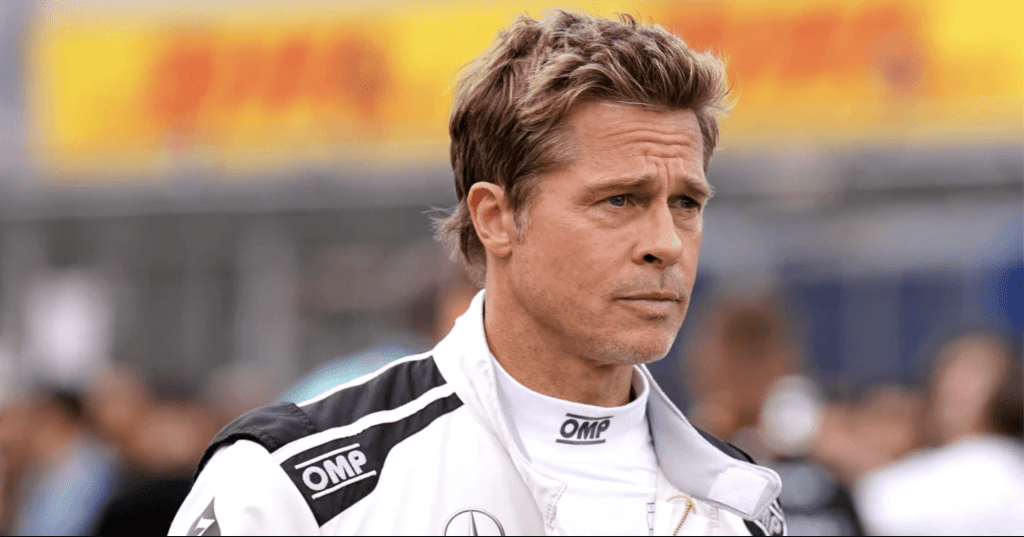
The commitment to realism shows. Pitt actually drove at speeds exceeding 180 mph while IMAX cameras captured every heart-pounding moment across real F1 tracks from Silverstone to Las Vegas to Abu Dhabi. That authenticity translated directly to ticket sales: premium formats including IMAX accounted for 55% of domestic revenues, with IMAX alone generating $27.7 million globally.
“With the most realistic racing sequences ever committed to film, ‘F1: The Movie’ quite simply demands to be experienced in IMAX,” said IMAX CEO Rich Gelfond. “Joseph Kosinski and Jerry Bruckheimer innovated and pushed our technology to new frontiers.”
Racing Against Time
The timing of “F1’s” success couldn’t be more crucial. The film faces formidable competition in the coming weeks, with “Jurassic World Rebirth” releasing Tuesday, July 2, followed by James Gunn’s highly anticipated “Superman” on July 11. Both represent the kind of franchise filmmaking that typically dominates summer box office.


But “F1” proves there’s still room for original, adult-oriented spectacle in today’s IP-dominated landscape. As David A. Gross of movie consulting firm FranchiseRe notes, “A lot about this movie looks easy, like a sure-fire hit, but it’s not. Race car films and sports dramas have a long and mixed track record. This time, everything is working.”
The Checkered Flag
For Apple, “F1” represents more than just a box office victory—it’s validation of the company’s entertainment strategy. After years of expensive lessons, Apple has finally cracked the code of combining prestige filmmaking with mainstream appeal. The film proves that audiences will still turn out for original stories when they’re told with sufficient skill, spectacle, and authenticity.
Whether “F1” can maintain its momentum against summer’s biggest franchises remains to be seen. But for now, Apple can finally claim what it’s been chasing since entering Hollywood: a genuine, crowd-pleasing blockbuster that puts the company in pole position for future success.
Game on, Hollywood. Apple is no longer just playing—it’s winning.