The works of William Shakespeare are so embedded within our cultural consciousness that it’s sometimes easy to forget they were written by a man as human as any of us. He had a life, a job, and a family like anyone else, and the staggering influence he would wield over the world after his death is likely something he never contemplated during his lifetime. It’s impossible to know with certainty what Shakespeare was thinking and feeling when he composed his plays, but Hamnet—both the film and the Maggie O’Farrell novel it’s adapted from—attempts to imagine what might have influenced the Bard to create his most celebrated work. It’s a highly fictionalized exploration of his life with intense focus on his wife Agnes (she’s more commonly known as Anne, but the film opts for the former) and the turbulent family life they shared.
Chloé Zhao Does It Again
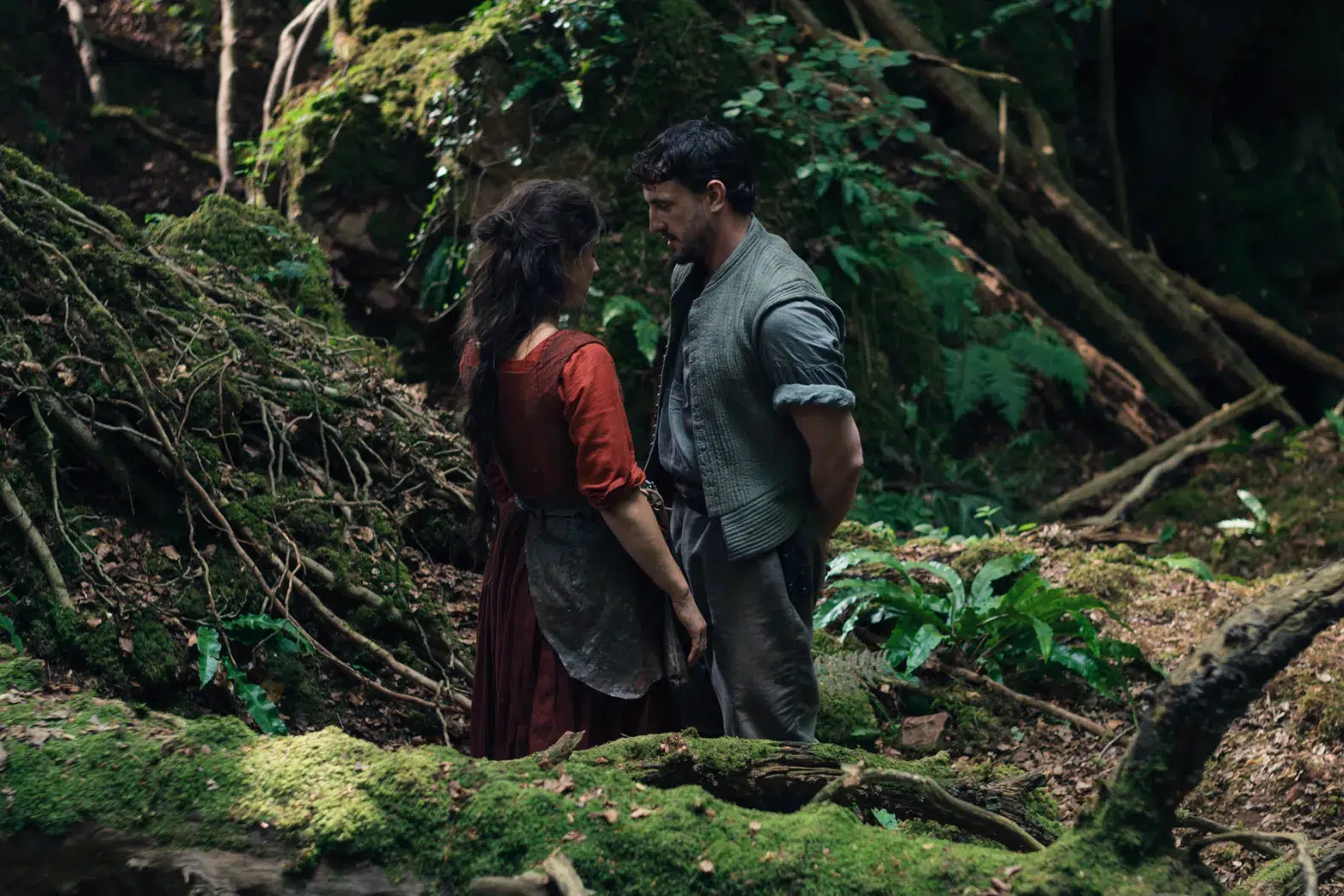
Coming from director Chloé Zhao of The Rider and Nomadland fame (she also directed Eternals for Marvel, if you can believe it), Hamnet opens on Agnes (Jessie Buckley), portrayed as the latest in a lineage of women regarded as witches of the wood. More comfortable with her feet in the dirt and a hawk on her arm than anything connected to civilization, she encounters William Shakespeare (Paul Mescal) while he’s teaching Latin to local children, and soon enough they’re kissing and cavorting their way to marriage. The connection between them is electric and volatile, formed perhaps a bit too quickly, leaving the opening scenes feeling somewhat rushed as Zhao accelerates toward the material she’s more invested in exploring. But the film settles into a more comfortable rhythm once Agnes delivers the first of three children, and the central concept can begin taking shape.
A Portrait of Shared Despair
What may initially appear to the uninitiated as a “great man struggling to balance work with family” drama instead becomes a portrait of shared despair when William and Agnes’ subsequent twins Hamnet (Jacobi Jupe) and Judith (Olivia Lynes) enter the picture. It’s historical fact that Hamnet died at age 11, but how the film portrays the circumstances leading to this tragedy and how the event unfolds not only provides the movie’s primary dramatic arc but also represents Zhao’s most formally appropriate choice. Agnes may not receive enough screen time dwelling within the woods to fully sell her apparently innate connection to the natural world (beyond the magnificent scene of her running off to give birth in the muck beneath a towering tree), but the subtle supernatural dimension to Hamnet’s death is the perfect touch to convey the crushing weight of his loss and how it would have a transcendent effect on the world through his father’s art.
The smartest aspect of the script is the way it reflects how personal tragedies influence artistic creation: sort of sideways.
Yet while the film does draw a direct line between Hamnet’s death and William writing Hamlet, it doesn’t attempt to force the connection where it doesn’t naturally belong. The most intelligent aspect of the script is how it reflects the reality of how personal tragedies influence artistic creation: somewhat obliquely. Art is a messy undertaking, and it rarely maps as a perfect metaphor to the artist’s lived experience. Hamlet, as a play, doesn’t correlate to every aspect of Hamnet’s life, nor would it even if his son’s death was definitively what prompted William to write it. But there are echoes of how William processes his grief in certain scenes from the play depicted in the film, such as King Hamlet’s ghost speaking to his son, or Hamlet’s iconic “to be or not to be” soliloquy. Zhao’s invocations not just of Hamlet but some of Shakespeare’s other works—such as a brief scene where the three children assume the roles of the witches from Macbeth—feel like natural extensions of the family dynamic that enhance the story being told.
Contrasting Performances That Complement Each Other
The fact that grief manifests differently in Agnes and her husband—with hers being more outward and his burrowing deep into his core—highlights the dichotomy not just between the characters but also between the performances of the actors portraying them. Saying that Jessie Buckley delivers greatness in a film is about as revelatory as noting “the sky is blue,” but she truly does exceptional work here, radiating kinetic energy even when the scene demands she remain still. Mescal’s performance is more uneven, sometimes striking the right balance between driven and melancholic while other times tipping too far into histrionics. This is best illustrated when Shakespeare begins yelling at his actors for not delivering lines as he envisions (a compelling scene), before contemplating suicide and seemingly improvising Hamlet’s most famous soliloquy on the spot (a less successful scene). Still, he mostly accomplishes what’s asked of him, and the young actors are excellent, with Jupe in particular being a standout who captures both the vitality of childhood and the tragedy of its premature end.
A Daring Final Sequence
But Hamnet truly succeeds or falters based on its final sequence, which represents one of Zhao’s most daring creative swings thus far in her career. It’s also the perfect distillation of Zhao’s thematic preoccupations, and will undoubtedly prompt considerable tears in any given audience. While I found the ending profoundly effective, others may consider it overly sentimental depending on their personal perspective. Regardless, it feels like the only appropriate way to bring the picture to a close, and for most viewers, it will likely send Hamnet out on an emotionally resonant high note.
A Film That Understands the Artist’s Heart
What makes Hamnet particularly special for fans of Shakespeare—and for anyone who’s ever channeled personal pain into creative expression—is its refusal to simplify the relationship between life and art. This isn’t a film that suggests Hamlet is merely a one-to-one retelling of the Shakespeare family’s tragedy. Instead, it understands that creativity is a complex, often inexplicable process where grief, love, guilt, and wonder combine in ways that even the artist can’t fully articulate. For those of us who’ve wondered what drove Shakespeare to create works that have endured for over four centuries, Hamnet offers one beautifully imagined possibility: that his greatest tragedy emerged from his most devastating loss, transformed through the mysterious alchemy of artistic creation into something that would speak to countless generations about what it means to be human.
Zhao brings her signature visual poetry to the material, capturing both the earthiness of rural England and the ethereal quality of grief that transcends time and place. The film’s quieter moments—Agnes touching the earth, the children playing in golden light, William’s silent contemplation—carry as much weight as its more dramatic sequences.
The Verdict
Hamnet is not without minor flaws—its opening rushes through the courtship, and Mescal’s performance occasionally reaches for melodrama—but it ultimately coalesces as a powerful dramatic achievement for director Chloé Zhao. Anchored by a phenomenal performance from Jessie Buckley and supported by remarkable work from the young cast, Hamnet simultaneously succeeds as an intimate family drama and as a meditation on how personal experience transforms into artistic expression. For fans of Shakespeare, for those who’ve experienced profound loss, and for anyone who’s ever wondered where art truly comes from, Hamnet offers a deeply moving answer that lingers long after the credits roll. This is filmmaking that honors both the man behind the legend and the timeless power of stories to help us process the unbearable.