When Jordan Peele’s name appears as producer on a horror project, audiences naturally expect something special.
After masterworks like Get Out and Nope, the bar is set impossibly high for any thriller bearing his involvement. Unfortunately, Justin Tipping’s Him serves as a stark reminder that even the Midas touch of modern horror’s golden boy can’t transform every project into gold.
This sports-centric thriller attempts to blend football drama with supernatural horror but stumbles at nearly every turn, despite a committed performance from Marlon Wayans that deserves a far better vehicle.
A Promising Setup Gone Wrong
Him opens with genuine intrigue, grounding itself in a familiar yet compelling sports narrative. We meet legendary quarterback Isaiah White (Marlon Wayans) during a career-defining moment—a horrific on-field injury that occurs as young Cam Cade watches from his living room, surrounded by team merchandise. The boy’s military father delivers a chilling piece of toxic masculinity: pointing to White’s mangled leg and declaring, “That’s what a real man looks like.”
This powerful opening sequence establishes the film’s central theme—the dangerous cult of masculine endurance in American sports culture. Fast-forward to Cade’s adulthood, where Tyriq Withers takes over the role as a rising college football prodigy. Meanwhile, White has not only recovered but transformed into one of the sport’s most revered figures, setting up what should be a compelling mentor-student dynamic with dark undertones.
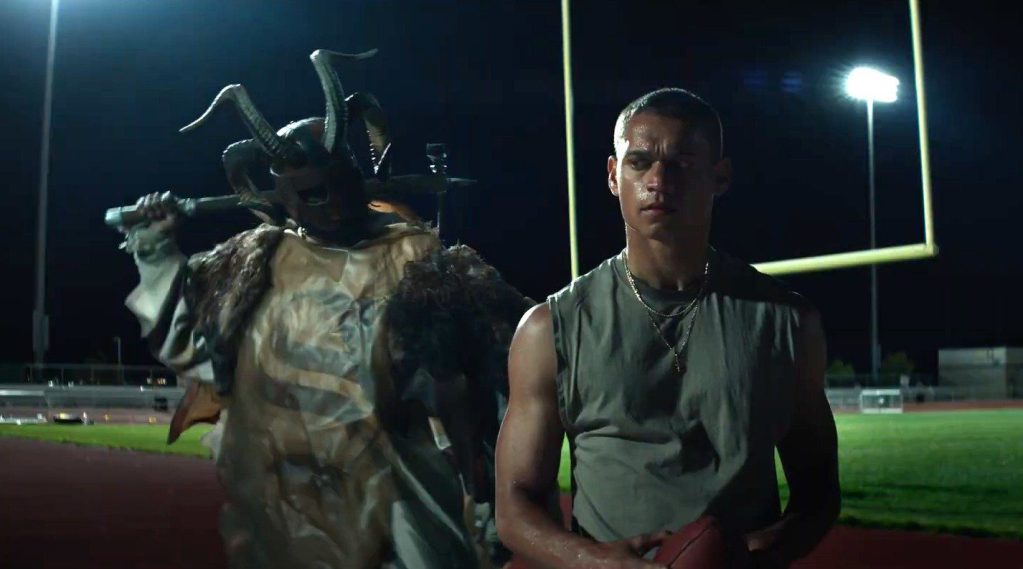
The premise practically writes itself: a young athlete idolizes the very person who might represent everything toxic about the sport. It’s rich material that Him proceeds to squander almost immediately.
Where the Wheels Come Off
As Cade approaches the professional draft (the NFL, tellingly never mentioned by name due to the league’s notorious litigation habits), Him introduces its supernatural elements. A rattling goalpost here, an infinitely spinning ball there—these phantasmagorical touches hint at something sinister lurking beneath the surface of professional athletics.
The imagery occasionally works. When Cade is attacked by a mascot figure, leaving him with scalp staples that resemble football stitches, there’s genuine visual poetry at play. It’s a perfect metaphor for how the sport literally reshapes those who participate in it. But rather than building on these inspired moments, Tipping seems content to let them float in isolation.
The film’s middle act, set during Cade’s week-long training at White’s isolated ranch, should be where the horror elements crystallize. Instead, we get what amounts to an ego-driven celebrity’s personal museum with occasionally creepy lighting. White’s sprawling bunker facility offers plenty of shadowy hallways, but lurking in that darkness are only the occasional visions of paparazzi—likely symptoms of Cade’s brain trauma rather than genuine supernatural threats.
Wasted Potential and Scattered Symbols
Perhaps most frustratingly, Him is packed with intriguing elements that never coalesce into meaningful narrative. The film gestures toward the cult-like nature of American football fandom, sprinkles in disconnected Christian and pagan symbolism, and even hints at homoerotic undertones in the athlete-mentor relationship. Yet none of these themes develop beyond surface-level acknowledgment.
Tipping does demonstrate skill in depicting football as visceral, uncomfortable violence. His use of X-ray footage showing the impact of each hit on bones and brains creates genuinely disturbing moments that could have anchored a more focused film about sports-related trauma. Instead, these powerful sequences feel disconnected from the supernatural thriller Him wants to be.
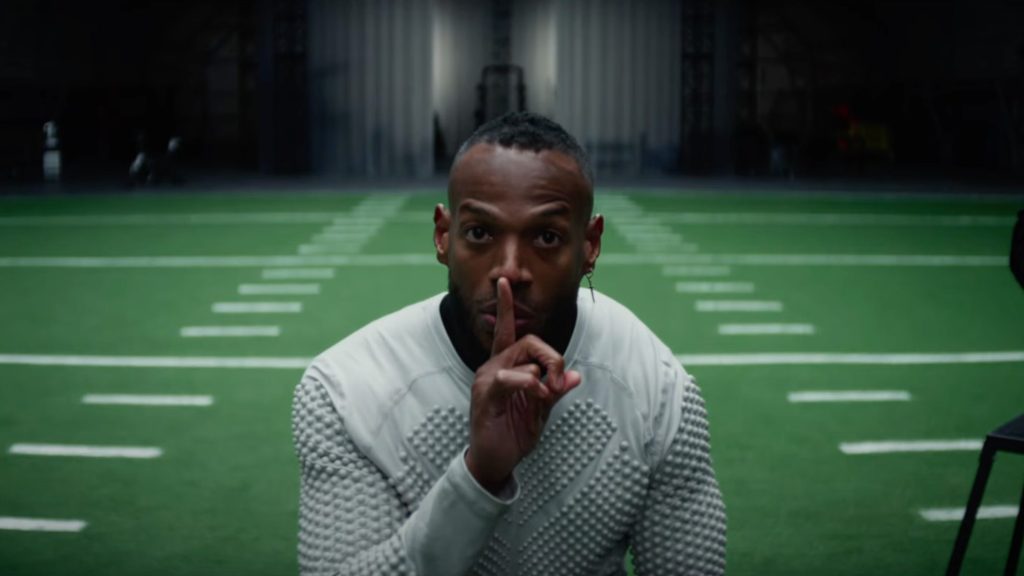
The performances provide the film’s only consistent strength. Wayans delivers a genuinely powerful turn as White, embodying both kindly mentorship and an unsettling obsession with violence that feels authentically dangerous. Withers does admirable work as Cade, searching for stable ground in an increasingly confusing scenario. Australian comedian Jim Jeffries provides the film’s most memorably creepy moments as White’s health specialist, injecting mysterious substances that hint at deeper corruption.
Technical Shortcomings
Beyond its narrative issues, Him suffers from fundamental technical problems that compound its storytelling failures. Haphazard camera coverage makes even simple dialogue scenes confusing, obscuring basic spatial relationships between characters. When the film reaches its climactic action sequences, this sloppy cinematography becomes actively detrimental to comprehension.
The low, blood-red lighting in White’s training facilities creates an occasionally imposing atmosphere that suggests deals with the devil, but the actual content never rises to match this visual ambition. It’s all style with no substance to support it.
A Confounding Climax
After 90 minutes that feel like an eternity, Him reaches its climax by “spouting off in a dozen different directions.” The film attempts to address how young athletes are exploited and bred for success against their own interests—a worthy theme that deserves thoughtful exploration. Instead, we get bloodshed without thematic weight and action sequences that feel like insufficient footage was shot to realize Tipping’s ambitions.
The ending raises more questions than it answers, but not in the intriguing way of Mulholland Drive or The Sopranos. These are questions born of confusion rather than artistic ambiguity, leaving viewers frustrated rather than contemplative.
Final Verdict
Him represents a particularly disappointing type of failure—a film with genuinely compelling source material and strong central performances that somehow manages to waste both. Despite Jordan Peele’s producing credit and Marlon Wayans’ committed performance, this football horror hybrid lacks the thematic coherence and genuine scares needed to succeed in either genre.
The film occasionally hints at the powerful thriller it could have been, particularly in its exploration of toxic masculinity in sports culture and the literal violence inherent in football. But these moments are overwhelmed by confused storytelling, technical incompetence, and a fundamental misunderstanding of what makes modern horror effective.
While Him may satisfy viewers looking for background noise during a lazy afternoon, anyone seeking the psychological complexity of Peele’s directorial work or even a competently constructed genre thriller will find themselves profoundly disappointed.
Rating: 5/10 Stars – A missed opportunity that wastes strong performances and compelling themes