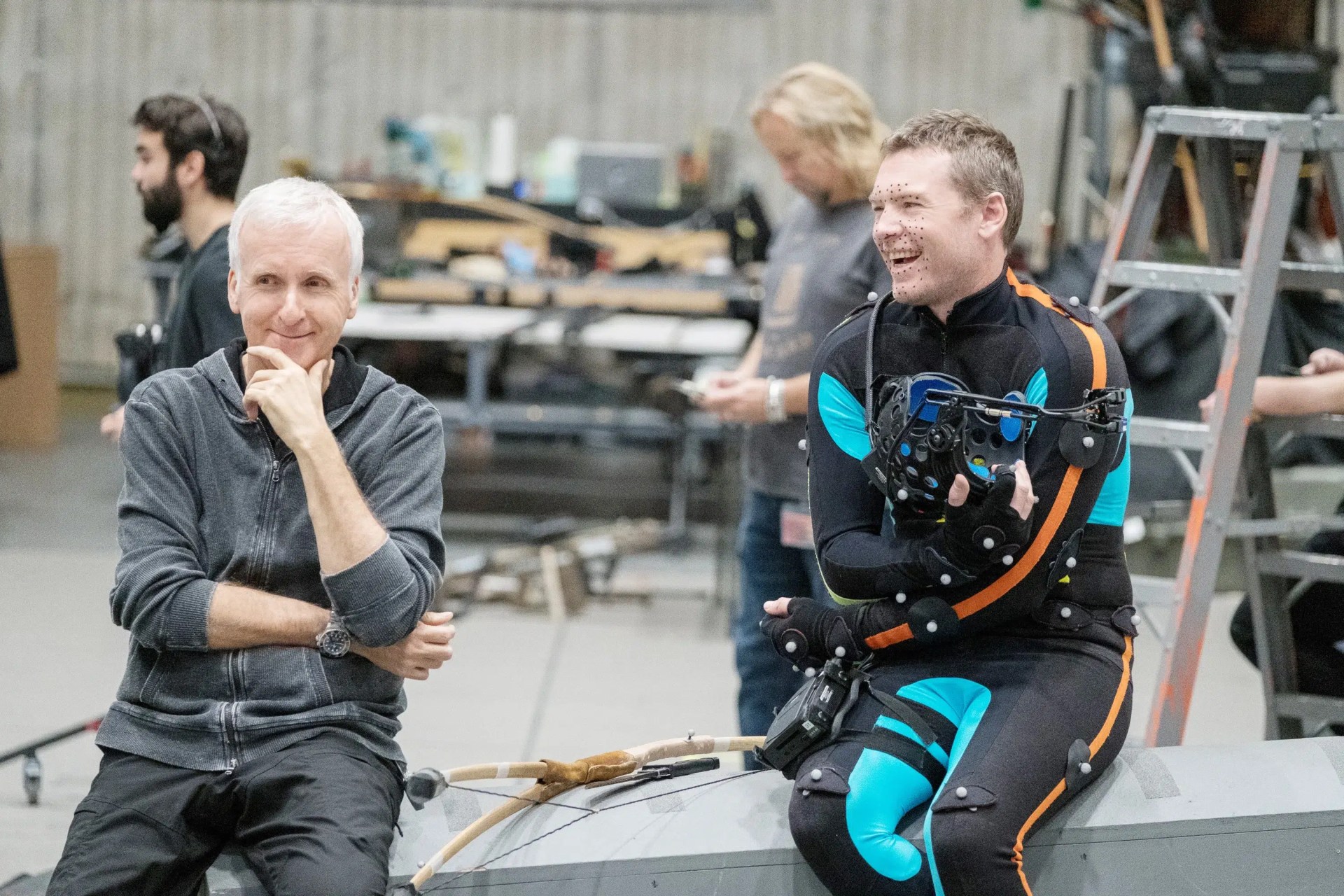
As “Avatar: Fire and Ash” prepares to transport audiences back to Pandora on December 19, director James Cameron is drawing a sharp line between his pioneering performance-capture technology and the growing trend of AI-generated actors.
In a recent interview with Deadline, the visionary filmmaker expressed alarm at the suggestion that his work with digital performers could be seen as a blueprint for AI replacement of human actors. “That’s horrifying to me,” Cameron stated bluntly. “That’s the opposite. That’s exactly what we’re not doing.”
The Sanctity of Performance
For Cameron, the distinction between performance capture and AI actors isn’t just technical—it’s philosophical. His process, which has powered both “Avatar” (2009) and “Avatar: The Way of Water” (2022) to become two of the highest-grossing films of all time, is fundamentally about amplifying human performance, not replacing it.
“For years, there was this sense that, ‘Oh, they’re doing something strange with computers and they’re replacing actors,'” Cameron explained. “When in fact, once you really drill down and you see what we’re doing, it’s a celebration of the actor-director moment, and the actor-to-actor moment. It’s a celebration of, I call it, the sanctity of the actor’s performance moment.”
This distinction is crucial. In Cameron’s Avatar films, every gesture, every facial expression, every emotional beat comes directly from the actors’ performances. The technology doesn’t create the character—it translates the actor’s work into a different visual form while preserving every nuance of their performance.
Technology Serving Humanity
Cameron’s perspective makes sense given his unique background in filmmaking. He entered the industry after watching “Star Wars,” drawn specifically to technological advances in special effects. He worked as a model maker for Roger Corman before moving into directing with “Piranha II: The Spawning” (a film he now disowns).
Throughout his career, Cameron has consistently pushed technological boundaries. “Terminator 2: Judgment Day” (1991) was the most expensive film ever made at the time, with much of its budget devoted to the groundbreaking CGI used for the liquid-metal T-1000. Six years later, “Titanic” again broke budget records with its faithful recreation of the doomed ocean liner and its sinking.
But Cameron has never let technology overshadow the human element. His films are as emotionally resonant as they are visually spectacular—from the parent-child relationships in “Aliens” and “Avatar: The Way of Water,” to the romance in “Titanic,” to the bond between John Connor and the T-800 in “Terminator 2.”
The Human Element
“I don’t want a computer doing what I pride myself on being able to do with actors,” Cameron declared. “I don’t want to replace actors, I love working with actors.”
This passion for performance explains why the Avatar films have connected with audiences on such a massive scale. Despite featuring nine-foot-tall blue aliens, these movies work because the characters feel genuinely human—because they are human performances, just rendered in a different form.
Cameron goes further, describing generative AI as “the other end of the spectrum” from his approach. Unlike performance capture, which preserves and translates human performance, AI can “make up a character, they can make up an actor. They can make up a performance from scratch with a text prompt.”
That fundamental difference—between capturing human artistry and generating something artificial—is what separates Cameron’s work from the AI future some in Hollywood seem eager to embrace.
Why This Matters Now
Cameron’s comments arrive at a critical moment for the entertainment industry. The 2023 writers’ and actors’ strikes centered largely on concerns about AI replacing creative workers. While those strikes resulted in some protections, the technology continues advancing rapidly, and studios continue exploring ways to reduce reliance on human talent.
Cameron’s defense of human performance carries weight not just because of his legendary status, but because he’s speaking from a position of technological expertise. This isn’t a Luddite rejecting progress—it’s an innovator explaining why certain innovations miss the point entirely.
The success of the Avatar films proves that audiences respond to human emotion, even when it’s filtered through layers of digital technology. Zoe Saldaña’s performance as Neytiri, Sam Worthington’s work as Jake Sully, and Sigourney Weaver’s portrayal of Dr. Grace Augustine aren’t diminished by being translated into Na’vi form—they’re enhanced by technology that allows these performers to inhabit characters they couldn’t play otherwise.
That’s the model worth emulating: technology as a tool to expand what human performers can do, not as a replacement for them.
“Avatar: Fire and Ash” releases in theaters on December 19, 2025, ready to once again demonstrate that the most advanced technology in filmmaking is meaningless without the human heart beating at its core.