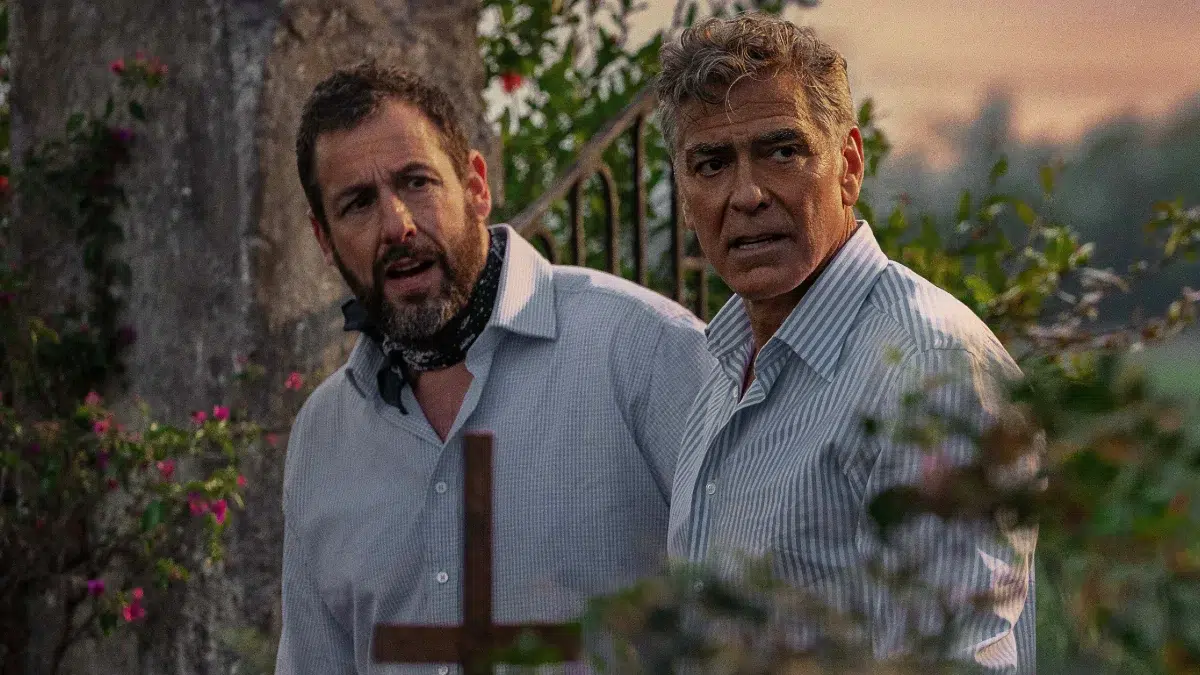
The cacophony of noises on the set of a major motion picture is enough to drive any person crazy. There’s yelling from all directions, person after person trying to get someone’s attention, equipment moving and shifting under your feet and everyone else’s. But in director Noah Baumbach’s latest feature Jay Kelly, the title character couldn’t be more at home in the chaos. It’s what he—a generational superstar actor beloved for his work over the course of about 40 years—knows best. But what he discovers as he approaches the twilight years of his storied career is that he maybe should’ve gotten to know other things better, namely his two daughters, who seem to be slipping through his fingers like grains of sand as they embark on their own lives.
This is, of course, the heart of this entertaining and deeply poignant examination of the life of great artists. Baumbach’s emotional intelligence as a filmmaker and writer (a duty he shares this time with actress Emily Mortimer) allows him to explore it gently and graciously with nuance, frank comedy, and stark sentimentality in a way that feels truthful and human despite the larger-than-life nature of the film’s subject. Oh, and on that note I should mention: Kelly is played by none other than George Clooney.
Clooney’s Personal Connection Elevates Everything
Clooney is the heart and soul of this film, not only because he’s an excellent actor who’s proven himself as such over the years, but because he innately understands what Jay Kelly is going through as a person. He’s lived that life—the life of someone who knows a thing or two about the personal sacrifices necessary in the face of great art. Jay Kelly is, ultimately, an obvious stand-in for Clooney himself, but that’s precisely why the character, and the film overall, works so beautifully. It’s a necessary element of Baumbach’s picture, especially considering the narrative is somewhat less personal to the director than many of his other works. Clooney’s intimate connection to the material acts as a surrogate for the autobiographical resonance Baumbach (Kicking and Screaming, The Squid and the Whale, Marriage Story) always brings to his stories, imbuing it with the same kind of authentic life his other projects have possessed.
This smart casting is crucial, because without Clooney’s personal investment, the film would lose much of its power. Kelly, as a product of Baumbach’s direction and writing combined with Clooney’s choices and instincts, is a beautiful disaster of a man—one who is noble in his trying and achingly human in his errors. He is, ultimately, just like any of us who try and try and try: We’re bound to make mistakes along the way. Watching Clooney inhabit this character with such vulnerability and self-awareness is genuinely moving, and fans of the actor will find layers they’ve never seen from him before.
Kelly is a beautiful disaster of a man, one who is noble in his trying and human in his errors.
An Ensemble That Feels Like Family
Kelly is, of course, nothing without the people who helped him throughout his career, the ones who ended up being a surrogate for the family he neglected. That’s where Adam Sandler delivers an excellent turn as Kelly’s manager Ron, who has been with him for his entire 40-year career. Sandler is known for his comedic brilliance, but has also proven himself in dramatic roles over the years, including in 2019’s Uncut Gems. Here his Ron is genuinely touching, drenched in charm and sadness in equal measure. It’s one of Sandler’s most understated and effective performances, and watching him share the screen with Clooney creates a chemistry that feels lived-in and authentic.
The supporting cast in general—namely Kelly’s team, made up of Sandler and Laura Dern as his publicist, as well as Greta Gerwig as Ron’s wife, Grace Edwards and Riley Keough as Kelly’s somewhat estranged daughters, and an exciting Billy Crudup as an old friend who resurfaces in a movie-stealing scene—brings the entire picture together in the same way an artist’s team brings together all the challenging elements of their extravagant and hectic lives so they can just be who the world wants them to be.
Dern is absolutely hilarious as she lays out some heartfelt truths worth examining about who your friends really are in this business. Her comedic timing is impeccable, but she also knows exactly when to let the mask drop and reveal the genuine affection beneath the professional relationship. Gerwig adds wonderful comedic relief to the project alongside Sandler’s real-life daughters and the young actor who splits sides as Ron’s son. These moments of levity are essential, providing breathing room in what could otherwise become oppressively melancholic.
Edwards and Keough are playing very different women with different goals and ideals, but they each bring a sense of independence and self-preservation to the roles that makes the crucial nature of their characters stand out. They’re both a joy to watch, though their ultimate paths are somewhat tragic for Kelly because he’s missed his opportunity to ride alongside them. Both performers embody that tragedy in their own ways, with Edwards’ quirky, free-spirited, and headstrong soul bare throughout her time in the narrative and Keough’s resentment and anger bubbling over with just the right amount of tension and consideration.
As for Crudup, he’s the one-two punch (no pun intended—if you know you know) of the film, and his turn, though brief, is revelatory for the same reasons Kelly praises him on screen: his ability to perform in every sense of the concept, and to breathe life and truth into every word, whether biting or tender. These performances collectively form the bedrock of Clooney’s ability to build a full, complex life around Kelly.
Baumbach’s Visual Poetry
Visually, Baumbach is also doing quite a bit of exploring here. His surreal approach to embodying Kelly’s mind—and by extension his regrets—is both fun and compelling to witness. It truly feels as though Kelly is walking through his own consciousness as he makes his way through every day, unable to help but remember the moments that have defined him and his life over the years. Baumbach has Kelly do this in the literal sense, as one doorway in one locale in the present leads to landscapes of haunting memory in the past.
It’s an effective cinematic device that allows Kelly to explore his emotional life, his mortality, and his accomplishments and failures both professional and personal—and how they have ultimately shaped who he was, who he is, and who he will be throughout the remainder of his career and life. For Baumbach fans, this represents some of his most visually ambitious work, and it serves the story beautifully without ever feeling gimmicky or overindulgent.
A Systemic Critique Wrapped in Personal Story
On its face, this film could ultimately be seen as a critique of what living for your art can take away from you—but I think there’s something smarter and more compassionate going on here. Jay Kelly feels more like a condemnation of the system we’ve set up for people who want to achieve greatness in art than a simple commentary on what you lose when you pursue a life in service of that goal. There’s room for both a worthy, impressive career and a fulfilling life with family and friends in the worlds of those who reach the level of celebrity we see in stars like George Clooney—but we don’t allow for that kind of work-life balance in Hollywood, not for those who want to achieve the heights of true fame.
I’d argue this film laments that notion and asserts that there has to be a better way, not only systemically but in changing the public’s mindset and perception of these stars. This is what makes Jay Kelly feel essential rather than indulgent—it’s not just about one man’s regrets, but about how our culture creates conditions that make those regrets inevitable for anyone who reaches the pinnacle of their profession.
One of Kelly’s defining quirks—and probably the quirk of most actors who are truly dedicated to their craft—is to ask for another take, to attempt another go at whatever line or scene he’s playing because he knows he could maybe, if the gods allow, do it better. At the end of this film, he revisits that notion for the umpteenth time, except it now means something wholly different and profoundly moving. It’s hard not to imagine how Jay Kelly’s life would have ended if the life of a star meant a life of balance, and it’s impossible not to see Kelly begging with his eyes to do it all over with that gift in hand.
A Gift for Fans and Film Lovers
For fans of George Clooney, this represents perhaps his most personal and vulnerable performance—a willingness to examine the costs of the life he’s lived with unflinching honesty. For fans of Noah Baumbach, it’s another masterclass in emotional storytelling that finds humor and heartbreak in equal measure. For fans of Adam Sandler’s dramatic work, it’s further proof that he’s one of our most underrated dramatic actors when given the right material.
But more broadly, Jay Kelly is a gift to anyone who’s ever wondered about the price of greatness, who’s ever sacrificed personal connection for professional achievement, or who’s ever looked back and wondered if there might have been a better way to balance the competing demands of career and family. Baumbach and Mortimer’s screenplay never judges Kelly—it simply observes him with empathy and asks us to consider what kind of world would allow someone like him to have it all without having to choose.
The Verdict
Jay Kelly is a deeply affecting portrait of stardom, sacrifice, and second chances that never were. Anchored by George Clooney’s career-best performance and supported by an ensemble that feels like a genuine family, Baumbach’s film examines the cost of artistic greatness with nuance, humor, and profound empathy. The surreal visual approach adds layers of meaning without overwhelming the intimate human story at its core.
This is a film that understands celebrity from the inside, that recognizes both the privilege and the prison of fame. It’s a love letter to the craft of acting while simultaneously questioning the systems that demand artists sacrifice everything for their art. For fans of thoughtful character studies, exceptional performances, and filmmaking that trusts its audience to feel deeply, Jay Kelly delivers something rare and special—a movie about a larger-than-life figure that makes him feel genuinely, achingly human.
Baumbach has crafted a film that will resonate with anyone who’s ever looked back at their choices and wondered “what if?” But rather than wallowing in regret, Jay Kelly asks us to imagine a world where we don’t have to choose between greatness and connection. That hopeful undercurrent, combined with the stellar craftsmanship on display, makes this one of the year’s most rewarding cinematic experiences.