Mercy opens in IMAX and 3D theaters now!
The screenlife genre gets a buggy, headache-inducing update in Timur Bekmambetov’s Mercy, a rapid-action thriller in which a man accused of murder must prove his innocence to an AI judge within 90 minutes or be put to death. This clockwork setting has genuine potential on paper, but what it ultimately lacks, ironically, is proper execution. It’s often unintentionally hilarious and frustratingly slapdash despite its conceptual prowess, and a prime example of genuinely intriguing ideas being squished together carelessly and squandered in service of a message that becomes increasingly uncomfortable the more you think about it. Not to mention, if you choose to watch it in 3D as seemingly intended, prepare for a physically demanding experience that may leave you reaching for aspirin.
A Strange Approach to Worldbuilding
Right from the get-go, Mercy takes a peculiar approach to explaining its futuristic setting, beginning with a neatly edited “previously on” montage that lays out how the crime-ridden, poverty-stricken Los Angeles of 2029 came to adopt AI-driven capital punishment as its solution to systemic problems. Hilariously, it turns out this expository trailer for the film’s own premise is being shown to an accused killer, Detective Chris Raven (Chris Pratt), who ought to be more than familiar with the imposing AI entity Judge Maddox (Rebecca Ferguson) since he personally pioneered the “Mercy” project that gives the film its name. Why does he need this explained to him? The film never bothers to clarify. Still, this exposition dump is somewhat forgivable, if only because it sets up the film’s parameters with the efficiency of LED screens lining the queue for a theme park ride at Disneyland.
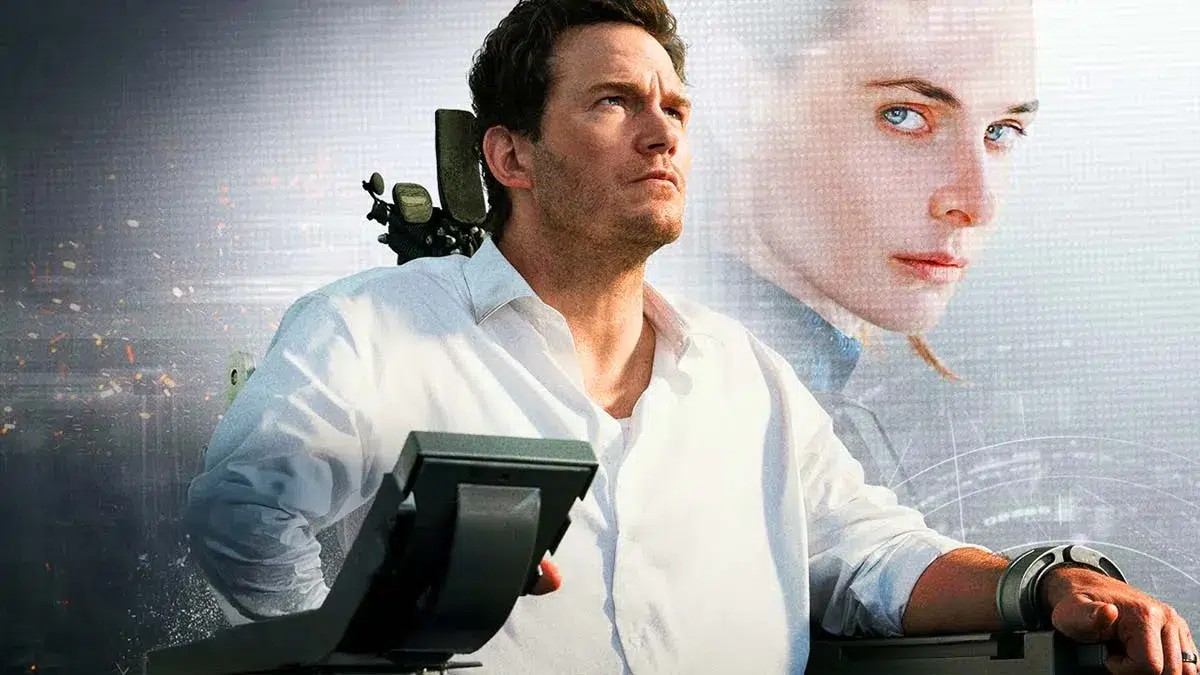
Raven, who’s just regained consciousness in an enormous, sterile empty room, is strapped to a lethal chair set to deliver a fatal electrical pulse unless he can prove he didn’t murder his wife Nicole (Anabelle Wallis) earlier that day. Before the restrained detective stands an enormous screen from which the imposing Maddox—her face dramatically silhouetted and cast in shadow—makes stern proclamations, deeming him “guilty until proven innocent,” and granting Mercy a not altogether uninteresting legal conundrum to explore. Maddox also has unlimited access to the digital and GPS data of literally everyone in LA thanks to a communal cloud system, which Raven can also sift through in order to prove his innocence. As either the judge or the accused bring up dueling evidence (courtesy of texts, doorbell videos, and countless other digital sources), iOS-style windows pop up in the space around Raven’s head like nifty 3D holograms. The case seems watertight: Raven arrived home during the work day, got into a fight with Nicole, and left, only for their teenage daughter Britt (Kylie Rogers) to find her mother stabbed to death minutes later.
It’s hard not to be perturbed by what Bekmambetov is selling with this film’s troubling ideological framework.
A Mystery That Unravels Too Quickly
The only problem is that Raven claims to have no memory of the events depicted, an idea that seems potentially intriguing until it’s quickly and disappointingly handwaved away without meaningful exploration. From that point on, as the on-screen clock counts down with increasing urgency, the story switches gears at absolutely breakneck speed and introduces a bewildering multitude of supporting characters via FaceTime calls, from Raven’s fiery police partner Jacqueline “Jaq” Dialo (Kali Reis) to his diligent AA sponsor Rob Nelson (Chris Sullivan), among many others who blur together.
The mystery is unraveled practically backwards, with clues being explained or exposed in the very same moment they’re first discovered—robbing the audience of any opportunity to piece things together ourselves. Meanwhile, Raven uses Jaq as his proxy to revisit the crime scene and even chase down other suspects in real-time, viewing the world through her body cam, then a dizzying series of drones, then digital renderings of real spaces, then insert-new-visual-idea-here without nearly enough time for us to adjust our eyes, let alone meaningfully reflect on what we’re seeing.
The movie switches focus just as haphazardly, going from tech conspiracy to domestic drama to some errant mixture of drugs-and-terrorism thriller that becomes impossible to invest in given the sheer overwhelming flurry of images and pop-up windows flying at you simultaneously. These visual elements are also never in the same plane of focus, forcing your eyes to constantly adjust faster than you can actually process the information being presented, which becomes even more physically demanding and genuinely uncomfortable if you’re watching in 3D as the film seemingly wants you to.
The Troubling Ideological Problem
However, what is perhaps strangest and most concerning about Mercy is what it has to say—and often, what it conspicuously doesn’t say—about technology, surveillance, and state power. Its setting involves an omniscient state apparatus that uses bare-bones facts to make snap judgments before sending people to their deaths via automated execution. And yet, this instant access to all facets of people’s lives doesn’t end up remotely framed as an ethical dilemma or inspire any hesitation whatsoever (the way it meaningfully does in, say, the climax of The Dark Knight).
The completely neutral approach to all-encompassing surveillance isn’t necessarily a bad thing in and of itself—after all, it’s the foundation of Mercy‘s mystery setting and creates the parameters within which the story operates. But paired with the film’s eventual distinctly pro-AI bent, despite simultaneously depicting AI as a fascistic entity that executes citizens without due process, it’s genuinely hard not to be deeply perturbed by what Bekmambetov is selling here, whether intentionally or not.
When the film eventually reaches its conclusion, it doesn’t critique or question the surveillance state or AI-driven justice system—it simply argues that these systems would work perfectly well if only the right humans were overseeing them and bad actors weren’t trying to abuse them. This is an astonishingly naive and potentially dangerous conclusion that the film practically narrates directly to the camera without apparent self-awareness.
Pushing Screenlife Past Its Breaking Point
Screenlife has been one of the more interesting and innovative filmic byproducts of the internet age, dating back to early webcam experiments like the French comedy Thomas in Love (2000) and the American supernatural horror film The Collingswood Story (2002), and culminating in various modern examples of the concept. Bekmambetov has personally produced a number of screenlife films: the Unfriended series; the father-daughter mystery Searching (2018); and the modern Shakespeare adaptation R#J (2021). He knows better than anyone that the central challenge of screenlife is working within the self-imposed limitations of telling a story as it plays out within the confines of computer screens and digital interfaces.
But with Mercy, Bekmambetov pushes the concept aggressively past its natural limits until it breaks entirely and becomes uninteresting and incoherent in the process. Sure, we see digital evidence through Raven’s eyes and perspective, but half the time the camera is incongruously focused on Pratt’s aggressive close-ups as the story reveals his character to be an unpleasant, borderline irredeemable husband and policeman whose innocence becomes genuinely hard to root for. Ferguson’s shadowy AI magistrate, by comparison, comes off as far more reasonable and even human in her approach to justice…which is an incredibly strange and presumably unintended outcome for a film ostensibly about the dangers of AI judgment.
There’s no real emotional challenge or meaningful cognitive dissonance in wanting Raven to break free from his predicament—the film’s approach to morality is dispiritingly flat and one-dimensional. Pratt often fails to imbue the character with realistic emotions or even the kind of theatrical showiness that might make Mercy work as an operatic romp in the Saw vein. If nothing else, watching Pratt struggle visibly with the thin material is at least a reminder of the flawed human artistry on display, even when the film seems to be championing the superiority of algorithmic decision-making.
Visual Chaos and Tonal Confusion
When the story eventually departs from its courtroom confines in its messy final act, the question of whose perspective—or whose cameras—we’re seeing the world through, and why, becomes just as nagging and distracting as the movie’s severe tonal inconsistencies and sloppily edited action scenes that cut frantically between too many visual sources. The promise of unfurling a screenlife story into three-dimensional space around a character forced to interact with digital information is genuinely an alluring concept, especially when it concerns the overwhelming wealth of data at Maddox’s and Raven’s fingertips.
And yet, Bekmambetov never goes beyond simply introducing these visual ideas and concepts, casting them into the ether without developing them or allowing them to serve the story in meaningful ways. In a world that’s as radically changed as the one we see here, and as theoretically dangerous to civil liberties, you desperately need a story that engages with its own premise on at least some thematic level, and allows its doomed protagonist to genuinely wrestle with notions of morality and his own personal culpability in creating this dystopian status quo.
Mercy is not only not that movie, but it also seems to almost salivate at the thought of a world where punitive instant justice and invasions of privacy are possible and technologically easy, presenting the only downside as rogue actors who might misuse these otherwise beneficial technologies—a conclusion that feels troublingly like corporate tech propaganda.
Why Even Make a Dystopia?
Perhaps the screenlife genre, or this particular rapid-fire version of it, simply isn’t the right creative venue for this material to begin with. On one hand, the constant barrage of images represents a kind of voyeuristic invasion and a troubling ceding of liberty and privacy, which might have been genuinely interesting to explore critically. On the other hand, the sheer overwhelming flurry of these invasive pop-up windows is also precisely how the movie attempts to conjure its few fleeting moments of visual intrigue and excitement.
Watching Mercy, it’s impossible not to wonder: Why even make a futuristic sci-fi movie explicitly set in a surveillance dystopia if your fawning aesthetic framing and ideological approach makes the setting feel distinctly utopic rather than cautionary? At that point, Bekmambetov may as well just invest in a generative AI company instead of making films critiquing the technology; oh, wait…he already has, which perhaps explains the film’s bizarrely uncritical stance toward the very technologies it should be interrogating.
An Uncomfortable Technological Endorsement
The film’s unwillingness to meaningfully engage with its own premise becomes increasingly frustrating as it progresses. We’re shown a world where privacy no longer exists, where AI can sentence you to death within 90 minutes based on algorithmic analysis, where the presumption of innocence has been completely inverted—and yet the film never treats any of this as inherently problematic. Instead, it suggests these are simply tools that need proper oversight, as if the fundamental issues with such a system are merely implementation details rather than existential threats to human rights and dignity.
This ideological blindness feels particularly egregious in our current moment, when conversations about AI ethics, surveillance capitalism, and algorithmic bias are more urgent than ever. Mercy had the opportunity to contribute meaningfully to these discussions through entertaining speculative fiction. Instead, it presents a vision of technological authoritarianism and then essentially argues that it’s fine as long as the good guys are in charge—a stance that’s not just naive but potentially dangerous in how it normalizes invasive surveillance and automated justice.
The Verdict
A genuinely headache-inducing screenlife experiment that straps Chris Pratt to a chair and holds its audience hostage right alongside him, Mercy comprehensively squanders its potential as a sci-fi thriller about the serious dangers of entwining justice and artificial intelligence. The result plays less like the tongue-in-cheek mystery-thriller director Timur Bekmambetov seems to be aiming for, and more like an inadvertent advertisement to tech investors and surveillance state apologists, making the movie chilling in deeply unintended ways that have nothing to do with its thriller mechanics.
The technical execution is frequently sloppy, the visual presentation is exhausting rather than innovative, the performances can’t overcome the thin characterization, and worst of all, the film’s ideological framework suggests a troubling lack of critical thinking about the technologies it depicts. In an era when we desperately need thoughtful science fiction that helps us navigate the ethical implications of emerging technologies, Mercy offers only flashy visuals in service of a worldview that uncritically embraces the very surveillance dystopia it should be warning us about.
There are far better uses of your time and money than subjecting yourself to this migraine-inducing exercise in missing the point of your own premise.
3.5/10 Stars
Mercy opens in IMAX and 3D theaters now!