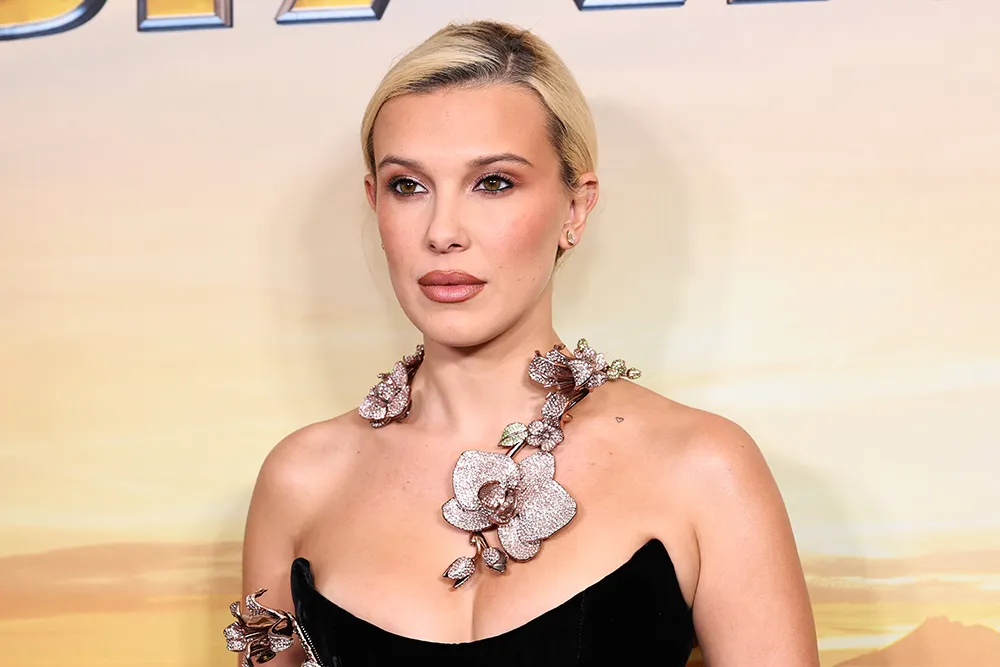
At just 21 years old, Millie Bobby Brown has already spent more than half her life in the spotlight. Now, the “Stranger Things” star is drawing a firm line between legitimate journalism and what she calls outright bullying—and she’s not holding back.
When Headlines Cross the Line
In a candid interview with British Vogue, Brown revealed the emotional toll of facing relentless criticism about her appearance during press tours. The breaking point came in March while promoting Netflix’s “The Electric State,” when a barrage of cruel headlines left her “crying every day.”
The actor didn’t mince words when describing the mockery embedded in those headlines: “‘Oh my God, what has she done with her face? Why has she gone blonde? She looks 60 years old!'” Brown recalled the inflammatory questions that tabloids posed as clickbait rather than genuine inquiry.
Articles with titles like “Why are Gen Zers like Millie Bobby Brown ageing so badly?” and “What has Millie Bobby Brown done to her face?” weren’t just invasive—they were devastating. Brown admitted these pieces left her “depressed for three, four days,” even leading to tears backstage at the BRIT Awards before she presented an award to Sabrina Carpenter.
Finding Strength in Solidarity
That backstage moment with Carpenter proved pivotal. As Brown got her hair and makeup done through tears, Carpenter’s unapologetic “Fuck ’em” mentality provided the validation she needed.
“I knew it inside of me, but when you hear someone else say it, you’re like, ‘Yes! That’s it!'” Brown remembered. That conversation helped crystallize her decision to speak out publicly.
Drawing the Line Between Journalism and Harassment
Brown emphasized that she respects legitimate journalism and even understands the invasive nature of paparazzi as “part of the job.” What she refuses to accept, however, is the normalized practice of tearing down young women in headlines designed purely for engagement.
“Don’t, in your headline, slam me at the get-go. It is so wrong and it is bullying, especially to young girls who are new to this industry and are already questioning everything about it,” Brown stated firmly.
Her March Instagram video addressing the issue didn’t just defend herself—it called out a systemic problem. “This isn’t journalism. This is bullying,” she declared. “The fact that adult writers are spending their time dissecting my face, my body, my choices, it’s disturbing.”
What stung particularly deeply? Many of these critical pieces were written by women. “The fact that some of these articles are written by women? Even worse,” Brown noted. “We always talk about supporting and uplifting young women, but when the time comes, it seems easier to tear them down for clicks.”
Refusing to Stay Frozen in Time
At the heart of Brown’s frustration is an impossible expectation: that she remain forever the child who first captured hearts on “Stranger Things” at age 12.
“If me being blonde or wearing more make-up really bothers you, I’m going to address it—not just for myself, but for every other girl who wants to try a new hairstyle or wear a red lip,” Brown explained. “It’s, like, get off my fucking case, you know? I am 21. I am going to have fun and play and be myself.”
In her viral video, she confronted this frozen-in-time mentality directly: “Disillusioned people can’t handle seeing a girl become a woman on her terms, not theirs. I refuse to apologize for growing up. I refuse to make myself smaller to fit the unrealistic expectations of people who can’t handle seeing a girl become a woman.”
A New Chapter, A New Priority
As Brown embarks on press tours for “Stranger Things 5″—the beloved Netflix series’ final season—her perspective has shifted dramatically. In late August, she and husband Jake Bongiovi welcomed an adopted baby girl, fundamentally changing what matters most to her.
Now, protecting her daughter from the very scrutiny she endured has become paramount. Brown told Vogue that keeping her daughter out of the spotlight until she’s old enough to choose for herself is essential.
“It’s not my place to purposefully put her in the spotlight unwillingly,” Brown explained. “If she chooses to share her personality one day with the world, like I did when I was young, that’s something we’d support. But right now, as she’s so little… As her parents, it’s our job to protect her from that.”
The Broader Conversation
Brown’s stand resonates beyond her personal experience. Her willingness to call out media bullying while simultaneously acknowledging legitimate journalism creates space for a necessary conversation about how young women in entertainment are covered—and whether generating clicks justifies genuine harm.
As she continues navigating life in the public eye, Brown has made one thing abundantly clear: she will not be shamed, she will not apologize for evolving, and she will not allow the media’s obsession with her appearance to define her narrative. For young women everywhere facing similar scrutiny, her message rings powerfully: refuse to be frozen in time, and never apologize for becoming who you’re meant to be.