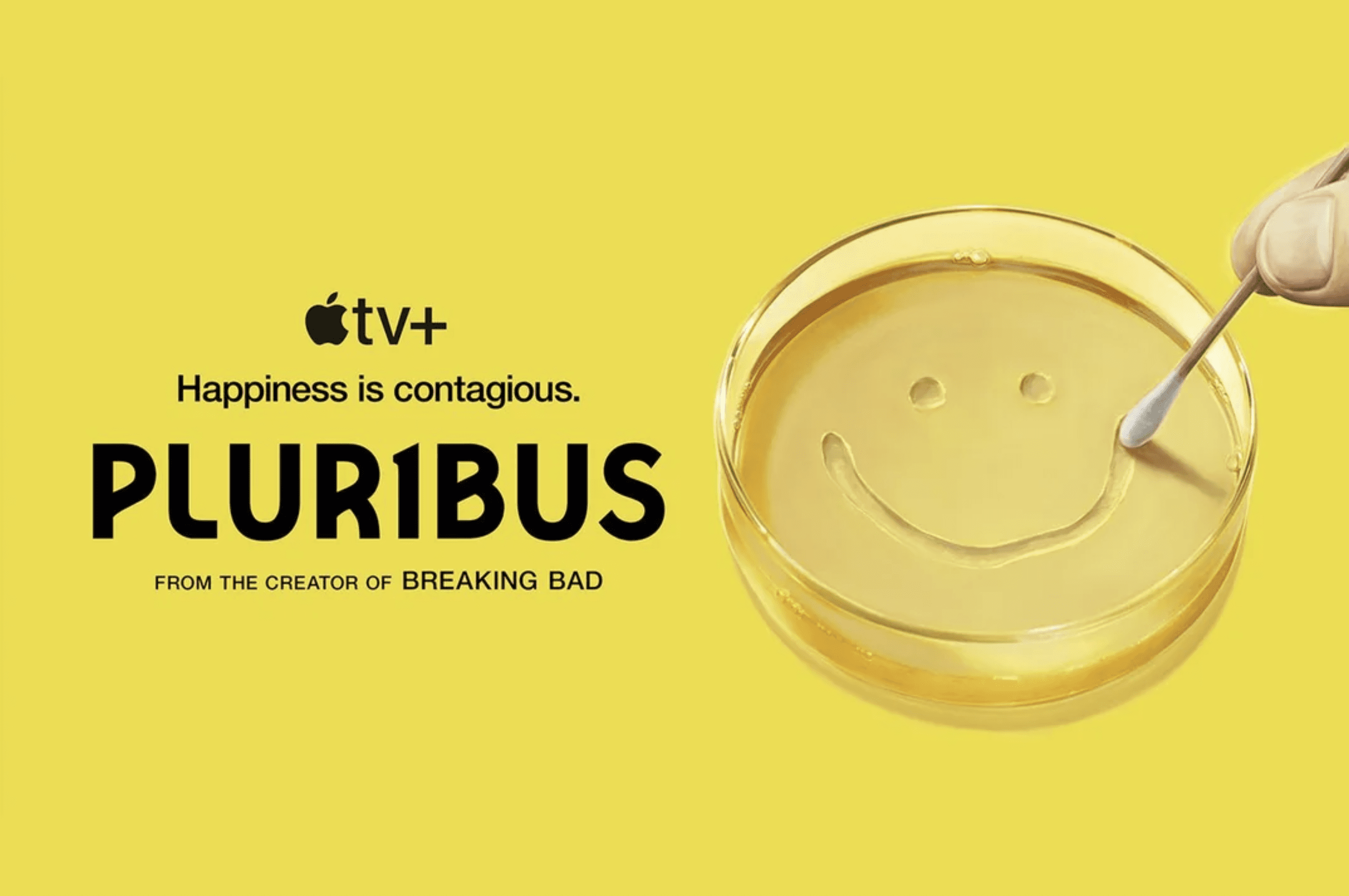
Full spoilers follow for Pluribus Episodes 1 & 2, “We Is Us” and “Pirate Lady,” now streaming on Apple TV+
Vince Gilligan is best known for creating Breaking Bad and its spin-off Better Call Saul, but the writer-producer-director actually cut his teeth in the pulpier sci-fi/horror trenches of The X-Files back in the ’90s. Between co-creating that show’s short-lived spin-off The Lone Gunmen and working on other genre projects, Gilligan has made clear he’s a science fiction fan himself, with Star Trek particularly near and dear to his heart.
So it’s no surprise that Pluribus, his new Apple TV+ series, has a science fiction bent. While Gilligan returns to weird and otherworldly concepts, he’s bringing his distinctly dark yet humorous tone for what is, based on the first two episodes, a unique spin on an age-old sci-fi notion.
Rhea Seehorn’s Cynical Novelist Gets the Worst Wake-Up Call
Better Call Saul‘s Rhea Seehorn reunites with her old showrunner, starring in Pluribus as Carol Sturka, a popular Diana Gabaldon-type romance novelist who’s great at interacting with fans at book signings but, once safely ensconced in her black car heading home from such events, unleashes her real feelings about her work.
“Should I know who you are?” her driver innocently asks.
Carol responds: “That depends. Are you a big fan of mindless crap?”
While her life partner and manager Helen (Miriam Shor) encourages Carol to finally finish the passion project she’s been working on for years—her “serious book”—the problem is the entire world is about to change in a big way.
The Premise: Invasion of the Body Snatchers, But the Pod People Already Won
The first episode takes its time establishing the premise, which involves a mysterious transmission from deep space providing humankind with an RNA formula. Long story short, the formula leads to a virus of sorts that eventually causes the minds of every person on the planet to merge into a single consciousness via “psychic glue.”
Yeah, it’s a lot. Some viewers might find the road getting there circuitous, as we follow random astronomers and scientists as this discovery goes from strange anomaly to, essentially, planetary invasion.
It’s Invasion of the Body Snatchers, but the pod people have already won by the time our hero character even figures out what’s going on. (Resistance is futile, don’t you know?)
When I say every person on the planet, I must amend that: it’s actually everyone except Carol and, we’re told, 12 other people from around the globe who for some unknown reason are immune to the virus’s effects.
This sets up a fascinating dynamic. Not only is Carol confronted with how she can move forward in this strange new world, but there’s also the matter of how the “Joined” rest of humanity will deal with her.
The Joined: Surprisingly Wholesome Hive Mind
Here’s where Gilligan really freshens up this take on pod people/Borg/what have you. While the Joined caused horrific damage and mass casualties (886 million dead, give or take) when they hurried the joining process by seeding the atmosphere with alien RNA after the military caught on, they seemingly are happy-go-lucky people (person?) who want nothing but the best for Carol and the other immune folks.
As Episode 1 nears its conclusion, there’s a great scene involving the Under-Secretary of Agriculture for Farm Production and Conservation, who’s live on C-SPAN just standing at a podium, quietly waiting for Carol to call so they can talk. Why the Under-Secretary of Agriculture for Farm Production and Conservation? Because he was “nearby, and intact, and he was wearing a suit.”
Seehorn is excellent in these moments, somehow depicting Carol as she digests not just the insanity erupting around her, but also the tragedy—which includes Helen dying after falling and hitting her head during the Joining. Yet there’s a slightly comedic vibe at times, as if the preposterous nature of the situation can’t wait to come out and play in future episodes.
Episode 2: Pirate Lady Arrives
By Episode 2, Gilligan (who wrote and directed both segments) fully embraces the literally out-of-this-world concept while having fun with it all. In an extended opening sequence, Karolina Wydra debuts as Zosia, a woman from the Middle East chosen as a spokesperson for the Joined because she kinda looks like the hunky (male) character from Carol’s romance novels (the Pirate Lady of the episode’s title). Not a bad idea!
In this sequence, we start getting a sense of how the Joined work, with every individual act serving a greater need. As Zosia moves from being yet another faceless participant in the cleanup effort the entire world is conducting, to modifying her look to be more Pirate Lady-ish, to piloting a cargo plane herself to the United States to meet Carol, it becomes clear the Joined have literally every resource—human, mechanical, and otherwise—at their disposal.
And yet they just seem to want to help Carol and the 12 like her. Or do they?
The Weight of Being One of Thirteen
Carol feels an obligation to restore the world, somehow, to its former self. But when she requests and is granted a meeting with the English-speaking members of the immune 12, she’s surprised to find most are either in denial about the situation’s true nature or just don’t care enough to resist the Joined. They’re complacent, and as a result, complicit.
Certainly, the Joined’s constant fawning over Carol is meant to evoke how her fans once treated her. While she was patient with that lot, she’s far less forgiving of her new fan club. Seehorn’s anger and sadness as Carol really add weight to the crazy idea at the center of this show, even while Carol’s biting wit and constant booze-guzzling keep us from going too far down the well of despair.
Meanwhile, Wydra has a very difficult task as Zosia, a character who—as a member of the Joined—is basically a cipher, but one we’re already starting to care about all the same. As Episode 2 closes and we see Zosia going off with one of the immune Others after Carol rejects her, her simple look back—in extreme wide shot, through an airplane window!—is kind of heartbreaking.
Questions and Notes From Kepler-22b
- Pause at 51 minutes and 47 seconds and you’ll see the radio signal seemed to come from the vicinity of Kepler-22b, an exoplanet orbiting the star Kepler-22 some 640 light-years away.
- I was surprised we already met some of the other 12 immune Others in Episode 2. The question now is what’s up with the ones Carol didn’t meet yet?
- Will we get flashbacks to the before times? Certainly Gilligan has done that with past projects. I’d like to see more of Miriam Shor as Helen.
- Speaking of which, what a cruel twist that not only did Helen die because of the Joining, but she also joined herself right before passing.
Can the Premise Sustain Itself?
The central question hanging over Pluribus is whether this premise can sustain a full season. The “last person who hasn’t been replaced by pod people” concept is inherently finite—there’s only so many variations you can play on “the whole world is against you” before it becomes repetitive.
But Gilligan has proven himself a master of taking seemingly limited premises and finding endless dramatic and comedic possibilities. Breaking Bad was ostensibly about a chemistry teacher making meth, yet it sustained five seasons of gripping television by constantly evolving its characters and situations.
The same could be true here. The Joined aren’t simply evil—they’re disturbingly benevolent, which creates moral complexity. Carol isn’t just fighting for survival; she’s wrestling with whether she even should fight, whether the world that exists now is somehow better than the one that came before, and what her responsibility is to the other immune individuals who don’t share her desire to resist.
The Gilligan Touch
What makes Pluribus work—at least in these first two episodes—is Gilligan’s distinctive voice. He understands that the most compelling science fiction uses its fantastical premise to explore very human emotions and dilemmas. Carol’s cynicism about her romance novels mirrors her cynicism about humanity itself, making her an interesting protagonist for a story about whether humanity is worth saving.
The show’s humor is also crucial. Without it, Pluribus could easily become oppressively bleak. But Gilligan finds absurdity in the apocalypse, whether it’s the Under-Secretary of Agriculture patiently waiting on C-SPAN or the Joined trying to seduce Carol into compliance by cosplaying her own fictional characters.
The Verdict
Vince Gilligan has taken a tried-and-true sci-fi idea and turned it on its ear with Pluribus, which goes the Invasion of the Body Snatchers route in a pretty fun and compelling way. Rhea Seehorn is simultaneously tragic and amusing as one of the only humans immune to the pod-person plague that overtakes the world, with co-star Karolina Wydra also proving to be a noteworthy presence in a challenging role.
The question is whether the premise can sustain itself for a full season. Based on Gilligan’s track record and the strong foundation laid in these first two episodes, I’m cautiously optimistic. The show has room to explore what it means to be individual in a world that’s collectively decided individuality isn’t worth keeping, and that’s a question with enough depth to carry multiple episodes—maybe even multiple seasons.
Pluribus isn’t just asking “what would you do if everyone else became pod people?” It’s asking “what if the pod people were right?” And that’s a far more interesting question.
I can’t wait to see where Gilligan goes next with this show.