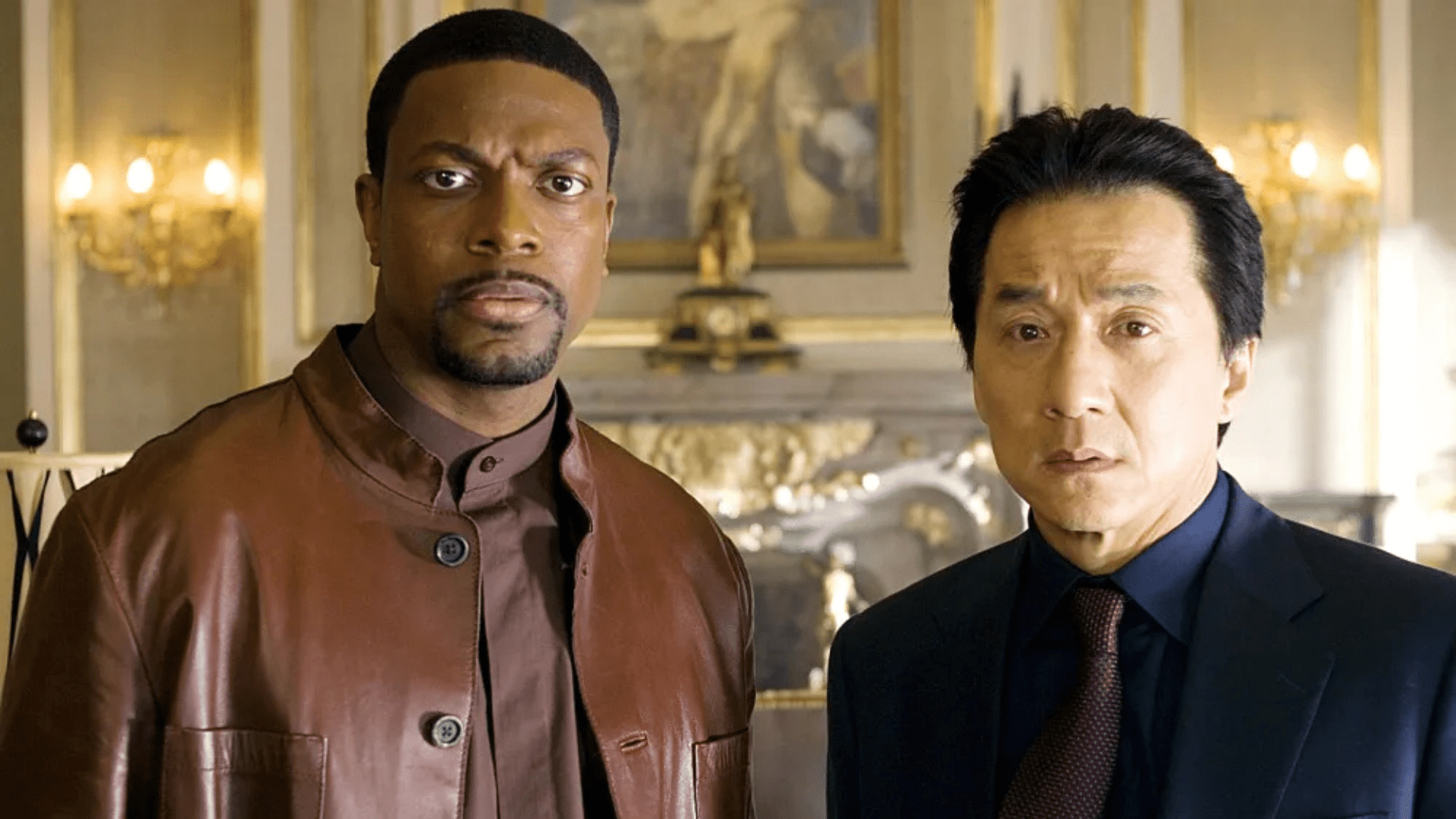
In one of the stranger Hollywood stories of 2025, “Rush Hour 4” is officially in development at Paramount Pictures—and according to reports, President Donald Trump personally requested that the studio revive the long-dormant buddy-cop franchise.
Yes, you read that correctly. The 47th President of the United States has apparently taken time out of running the country to advocate for another installment in the Jackie Chan and Chris Tucker action-comedy series. Welcome to the timeline we’re living in.
The Unusual Path Back to Production
According to Semafor, Trump’s involvement was a key factor in getting “Rush Hour 4” off the ground. The project has been in various stages of development for years, but the combination of presidential interest and Paramount’s desperate need for new content appears to have finally pushed it over the finish line.
Brett Ratner, who directed the first three “Rush Hour” films, will return to helm the fourth installment. This marks a significant comeback for the filmmaker, whose career was effectively ended in 2017 when multiple women accused him of sexual harassment and misconduct as part of the #MeToo movement. Ratner has largely been absent from Hollywood since those allegations surfaced, though he has denied all wrongdoing.
Ratner’s return to mainstream filmmaking comes after he directed “Melania,” a documentary about First Lady Melania Trump that Amazon paid $40 million to acquire. The project reportedly brought Ratner into the orbit of the first family, and that relationship appears to have paid dividends in getting “Rush Hour 4” greenlit.
“Rush Hour 4” will mark Ratner’s first theatrical feature film since 2014’s “Hercules,” which starred Dwayne “The Rock” Johnson and received lukewarm reviews despite modest box office success.
The Original Stars Are Back
Jackie Chan and Chris Tucker will reprise their roles as Detective Inspector Lee and Detective James Carter, respectively—the mismatched duo whose cultural clash and eventual friendship powered the original trilogy.
The first “Rush Hour,” released in 1998, followed two police officers forced to work together to rescue a Chinese diplomat’s abducted daughter. The fish-out-of-water comedy—pairing Chan’s martial arts mastery and straight-man demeanor with Tucker’s rapid-fire motormouth comedy—struck gold with audiences, earning $244 million globally on a $33 million budget.
The sequels proved even more lucrative. “Rush Hour 2” (2001) earned $347 million worldwide, while “Rush Hour 3” (2007) brought in $258 million—though both received mixed-to-negative reviews from critics who felt the formula was growing stale.
Age and Timing Concerns
One significant question mark hanging over “Rush Hour 4” is the age of its stars. Jackie Chan is now 71 years old, and while he’s remained remarkably active in Hong Kong cinema, his ability to perform the kind of elaborate martial arts sequences that defined the original trilogy is uncertain. Chan has spoken publicly in recent years about the physical toll his decades of stunt work have taken on his body.
Chris Tucker, meanwhile, hasn’t headlined a major theatrical release since “Rush Hour 3” in 2007—a nearly two-decade gap. Tucker has done stand-up comedy and occasional small film roles in that time, but his profile has significantly diminished since the peak of his “Rush Hour” fame.
The question of whether audiences in 2025 and beyond will be interested in seeing these characters—now played by actors in their 70s and 50s—remains very much open.
A Complicated Distribution Deal
The business arrangements behind “Rush Hour 4” are almost as interesting as the presidential involvement.
Paramount will receive a flat distribution fee to release the film theatrically but won’t be responsible for financing or marketing the movie. This structure essentially makes Paramount a hired gun—they’ll handle the logistics of getting the film into theaters, but they’re not putting their money at risk.
Meanwhile, Warner Bros.—whose New Line label released the original trilogy—will receive first-dollar gross, meaning the studio gets a percentage of box office revenues before anyone else recoups their costs. This is an extremely favorable deal for Warner Bros., which gets a financial upside without having to do any of the work of actually releasing the film.
According to sources, multiple distributors were approached after Warner Bros. allowed Ratner and the producers to shop the project around Hollywood. However, none wanted to be publicly associated with the film due to Ratner’s involvement and the #MeToo allegations against him. Paramount was apparently willing to take the reputational risk—or perhaps felt pressure from other sources to do so.
Why Paramount Said Yes
Understanding Paramount’s willingness to distribute “Rush Hour 4” requires understanding the studio’s current situation.
Paramount was recently acquired by Skydance Media in a deal that created a new entity called Paramount Skydance. The merged company is under tremendous pressure to increase output: currently releasing about eight films per year, the studio has set aggressive goals of 15 annual releases by 2026, 17 by 2027, and 18 by 2028.
Meeting those targets requires a constant pipeline of new projects. “Rush Hour 4” represents a relatively low-risk way to add a title to the slate—Paramount isn’t financing the film, they’re just distributing it, so even if it flops, the studio’s financial exposure is limited.
There’s also the Trump factor. Paramount’s new chairman and CEO is David Ellison, son of billionaire Larry Ellison—one of Trump’s most prominent financial supporters and allies. The president has publicly praised David Ellison’s leadership of Paramount. When the sitting president personally requests that a studio make a particular movie, and that studio happens to be run by the son of one of the president’s biggest supporters, the political calculus isn’t difficult to decode.
The Comedy Problem
Beyond the age of its stars and the controversy surrounding its director, “Rush Hour 4” faces another significant challenge: comedies have largely fallen out of favor at the box office.
In the years since “Rush Hour 3” dominated theaters in 2007, the theatrical comedy has become an endangered species. Audiences increasingly opt to watch comedies at home on streaming services rather than paying to see them in theaters. The few comedy hits of recent years—films like “Barbie” (which is more of a comedy-adjacent spectacle) and “Anyone But You” (a rom-com that succeeded partly through viral TikTok marketing)—are exceptions that prove the rule.
The “Rush Hour” franchise thrived in an era when mid-budget comedies could routinely gross $200-300 million worldwide. That era is largely over. Whether a fourth installment can recapture that magic in a vastly different theatrical landscape is highly questionable.
The #MeToo Elephant in the Room
Any discussion of “Rush Hour 4” must address the elephant in the room: Brett Ratner’s return to mainstream Hollywood filmmaking represents a test case for whether #MeToo consequences have staying power or whether enough time and the right connections can rehabilitate even seriously damaged careers.
In November 2017, multiple women—including actresses Olivia Munn and Natasha Henstridge—accused Ratner of sexual harassment and misconduct. The allegations ranged from inappropriate behavior to sexual assault. Ratner denied the accusations through his attorney but effectively disappeared from Hollywood in their wake.
His work on the “Melania” documentary appears to have provided a path back into filmmaking, and his relationship with the Trump family has clearly opened doors that might have remained closed otherwise. Whether audiences will accept his return—or whether they’ll care enough to boycott “Rush Hour 4″—remains to be seen.
The fact that multiple distributors reportedly passed on the project specifically because of Ratner’s involvement suggests there’s still significant reputational risk associated with working with him. Paramount’s willingness to proceed anyway is notable, though the structure of the distribution deal minimizes the studio’s exposure.
What’s Next
No timeline has been announced for “Rush Hour 4,” and with Chan’s age and the need to develop a script, pre-production could take considerable time. Don’t expect to see this in theaters in 2025.
The bigger question is what kind of story “Rush Hour 4” will tell. The original trilogy dealt with cultural misunderstandings, international crime syndicates, and the evolving friendship between Lee and Carter. Nearly 20 years later, with both characters presumably nearing retirement age, what adventure could be compelling enough to justify another film?
Perhaps more importantly: Does anyone actually want this movie? The “Rush Hour” franchise was a product of its time—the late ’90s and early 2000s, when this particular brand of buddy-cop comedy thrived. Nostalgia is powerful, but it’s not clear that nostalgia for “Rush Hour” specifically is strong enough to drive audiences to theaters in 2026 or 2027.
Then again, stranger things have happened. And in a world where the President of the United States is personally advocating for action-comedy sequels, perhaps “Rush Hour 4” is exactly the kind of absurd, feel-good escapism we need.
Or perhaps it’s just another example of political connections trumping artistic merit and industry standards. Time will tell.