Music biopics have become Hollywood’s comfort food—crowd-pleasing rags-to-riches tales set to jukebox hits, following a formula so predictable you could set your watch by the “childhood trauma” scene and the “record executive says no” confrontation. Springsteen: Deliver Me From Nowhere boldly rejects that template, delivering instead an intimate, 1970s-style character study that just happens to feature a burgeoning rock star as its protagonist.
Directed by Scott Cooper (Crazy Heart), this adaptation of Warren Zanes’ book focuses exclusively on the two-year period when Bruce Springsteen created his 1982 masterpiece Nebraska—arguably his most daring and best album. That narrow timeframe is already a blessing in a genre drowning in bloated cradle-to-grave entries. But Cooper takes it further, crafting a small, introspective drama about a depressed guy writing sad songs about serial killers and lost souls.
This is the anti-Elvis, rejecting Baz Luhrmann’s maximalist approach for something quieter, more contemplative, and far more interested in sitting with its subject than racing through greatest hits.
Jeremy Allen White Embodies The Boss
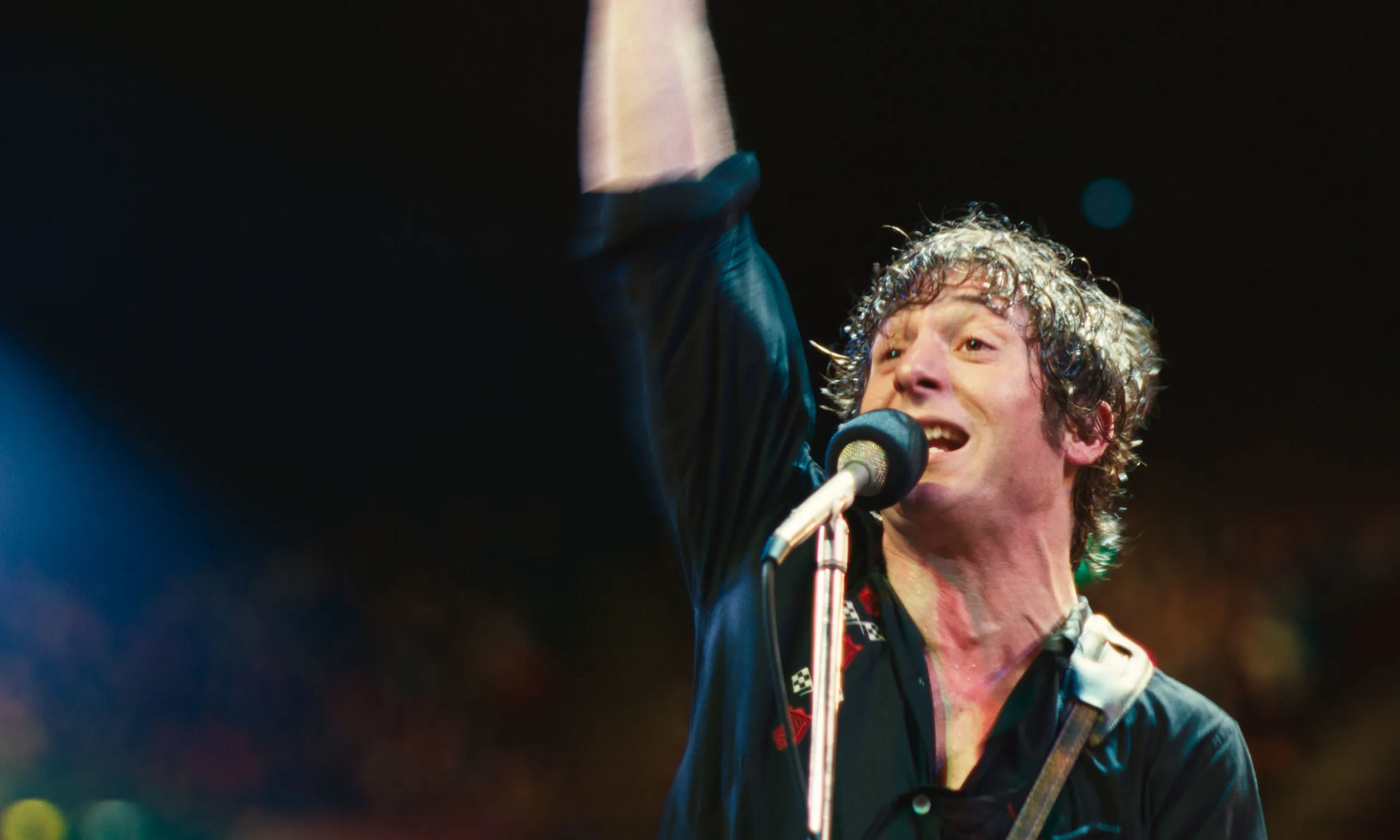
Playing Bruce Springsteen could easily become an impression, a collection of tics and mannerisms that signal “rock star” without capturing humanity. Jeremy Allen White avoids that trap entirely, delivering a brooding, soulful performance that reveals deep internal life through posture and meaningful glances. His brown contact lenses match Springsteen’s eyes, but it’s what’s behind them—vulnerability, confusion, mounting anxiety—that sells the character.
White also impresses with his own singing of Springsteen’s classic tunes, recreating both studio and stage performances with conviction. But it’s in the quieter, lonesome moments that he truly shines, conveying the paralysis of depression and the desperation of an artist unable to articulate what’s eating him alive.
Bruce has just achieved mainstream success with Born to Run and The River. He’s poised to become a big-time rock star—eventually America’s working-class poet laureate. The powers that be want another Top 10 hit. But that’s not what Bruce needs to make. Something is profoundly wrong with him, and if he doesn’t purge that darkness through the (less commercially appealing) songs stirring inside him, there’s a very real chance he won’t survive to make another Top 10 hit again.
The Making of Nebraska: Lo-Fi Rebellion
Deliver Me From Nowhere lovingly documents the by-modern-standards lo-fi approach Springsteen embraced for Nebraska. Bruce and his guitar tech Mike Batlan (Paul Walter Hauser, solid as always) weren’t even trying to make an album—they were cutting a cassette demo in Bruce’s bedroom.
It wasn’t until Bruce entered the studio with the E Street Band, attempting to recreate those raw recordings and failing repeatedly, that he made the risky career move of simply releasing the demo, imperfections and all. His record label, personified by David Krumholtz’s exasperated executive, was understandably concerned. You don’t follow up chart-toppers with bedroom recordings about Charles Starkweather’s 1950s killing spree.
But that’s exactly what made Nebraska revolutionary—its refusal to compromise darkness for commercial appeal, its embrace of imperfection as authenticity.
Structure: Slow Build to Emotional Payoff
The film’s slow-moving first hour flirts dangerously with rock biopic clichés. We watch Bruce find inspiration for key songs, like the title track Nebraska (inspired by Terrence Malick’s Badlands, itself a fictionalized take on the Starkweather murders). These moments risk feeling paint-by-numbers—the “inspiration strikes” sequences that plague lesser music biopics.
But the second half strengthens considerably as Bruce’s anxieties and crippling depression mount. He struggles with the album that exists in his head but which he can’t seem to capture in the studio. This unfolds against unresolved issues with his alcoholic, abusive, and mentally ill father Douglas (Stephen Graham, delivering quiet menace and unexpected pathos) and his relationship with hometown girl Faye (Odessa Young), threatened by his emotional withdrawal.
The Depression Dilemma
Dramatizing the act of writing and the curse of depression is cinematically challenging—both involve isolation and internal thoughts audiences aren’t privy to. Cooper’s screenplay strains against this limitation, sometimes clumsily ensuring there’s no uncertainty about what’s driving Bruce.
Producer-manager Jon Landau (Jeremy Strong in a rare good-guy role, understated and empathetic) often articulates Bruce’s state of mind to others, including his wife (Grace Gummer in a thankless, largely dialogue-free role). These sequences feel on-the-nose, a screenwriting shortcut that undermines the film’s otherwise subtle approach.
The black-and-white flashbacks to Bruce’s blue-collar youth in Freehold, New Jersey, work far better, explaining through imagery rather than exposition the root causes of Bruce’s demons. Cooper understands that showing Douglas’s volatility and young Bruce’s fear communicates more than any therapy session could.
It’s important to emphasize that in the early ’80s, anxiety and depression were taboo subjects most people—famous or otherwise—didn’t recognize or address. Bruce himself and those around him don’t fully understand what’s happening to him. That historical context makes the film’s exploration of mental health quietly revolutionary for the music biopic genre.
Stephen Graham’s Quiet Power
While Jeremy Allen White and Jeremy Strong have dominated the promotional cycle—their brothers-in-arms bond offering a healthy, compassionate counter to, say, the toxic Elvis/Colonel Parker relationship in Luhrmann’s film—more kudos belong to Stephen Graham.
Graham brings Bruce’s deeply troubled father to life with few words and the threat of violence always simmering beneath the surface. He makes Douglas terrifying and tragic in equal measure. The film ultimately finds humanity in this damaged man, offering him the sort of redemption many characters in Bruce’s own songs desperately yearn for.
Supporting Players and Missed Opportunities
Unfortunately, several characters chew up screen time without justifying their presence. Bruce’s motorcycle mechanic friend who drives him to California? Who is he exactly? Marc Maron appears mustache-less as studio producer Chuck Plotkin, doing several scenes without a single line of dialogue. Why hire someone of Maron’s stature for a background role?
Odessa Young shines in limited screen time as Faye Romano, a waitress, single mom, and sister of Bruce’s high school classmate. But learning Faye is a composite character—an amalgamation of several women Bruce dated—deflates her scenes retroactively. In a film taking such pains to appear authentic, from New Jersey locations to vintage recording equipment to Springsteen’s own involvement on set, discovering one of the most integral relationships is fictional feels off-putting.
Not Your Typical Music Biopic
Deliver Me From Nowhere is refreshingly small in scope and stakes-deficient by showbiz biopic standards. This isn’t about a rock star who lives fast and dies young from excess and fame’s trappings. This is a hopeful story about a flawed, vulnerable human being who confronts their pain and survives to see better days and greater success.
Whether the film introduces The Boss to a new generation or merely appeals to aging fans remains to be seen. Its measured pace, lack of conventional conflict, and refusal to deliver familiar biopic beats may limit its appeal. But as a character study of an artist trying to find his true self before celebrity engulfs him, Cooper’s film succeeds more often than it stumbles.
The Verdict
Springsteen: Deliver Me From Nowhere has its hungry heart in the right place, even if execution occasionally turns clumsy and clichéd. It’s a throwback, indie-style drama that respects both its subject and its audience enough to move slowly, sit quietly, and explore depression with nuance rarely seen in the music biopic genre.
Jeremy Allen White delivers an awards-worthy performance that does The Boss justice, capturing not just Springsteen’s voice and physicality but his inner turmoil. Jeremy Strong and Stephen Graham provide excellent support, while Scott Cooper’s direction favors intimacy over spectacle.
If you’re seeking a crowd-pleasing jukebox musical, look elsewhere. But if you want to understand the darkness that produced one of rock’s most uncompromising albums, and witness an artist choosing authenticity over commercial success at the peak of his powers, Deliver Me From Nowhere delivers exactly that—a small, sincere portrait of creativity and survival.
Sometimes the most important albums—and films—aren’t the ones that give audiences what they want, but what they need.