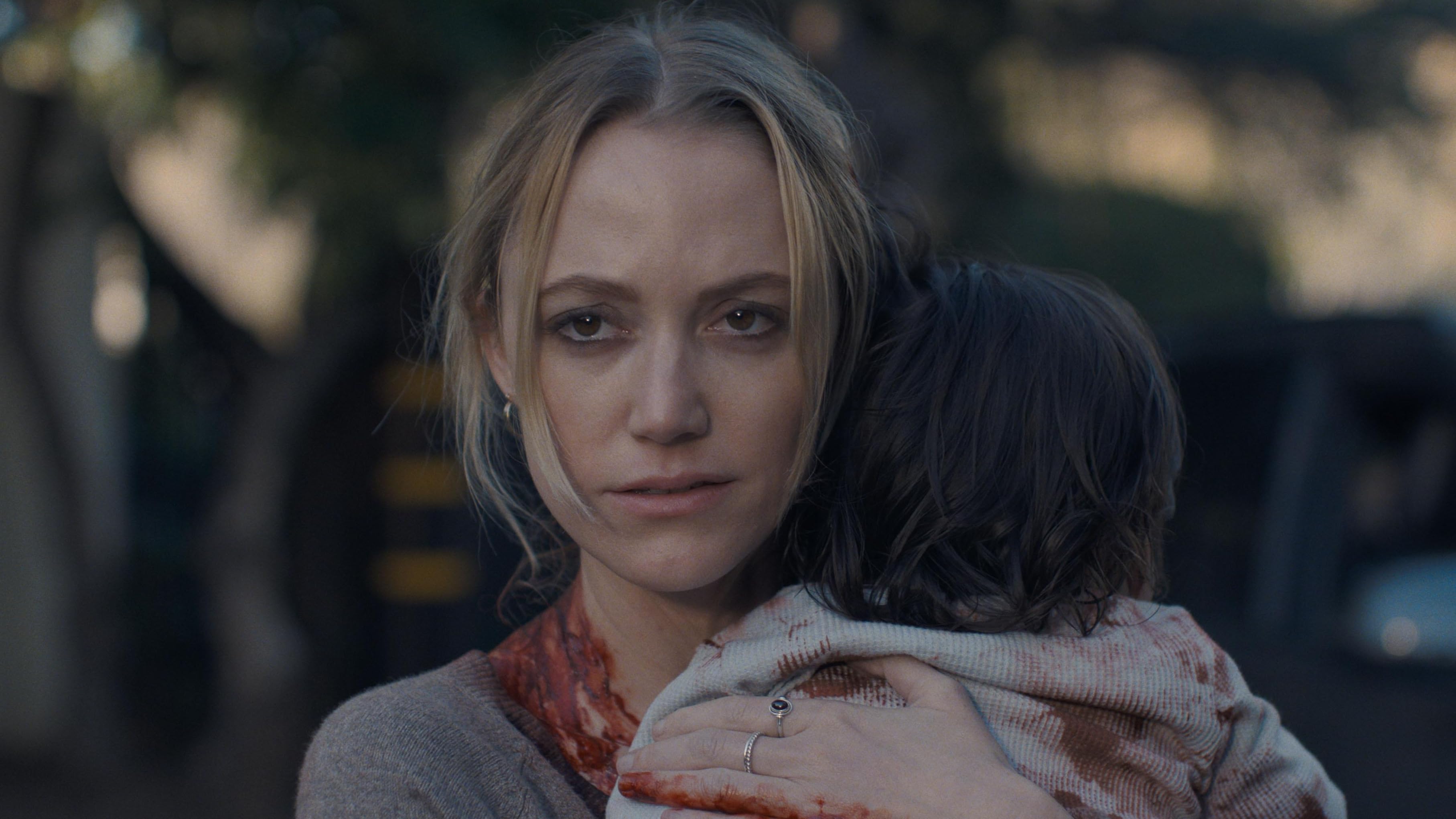
Now streaming on Hulu
Not all remakes need to justify their existence—sometimes enough time passes that a fresh take can stand on its own merits, assuming it’s actually good. Hulu’s 2025 remake of Curtis Hanson’s 1992 psychological thriller The Hand That Rocks the Cradle lands awkwardly between “not so horrible” and “not so great,” a film bursting with fascinating ideas it’s too cautious to fully explore.
The Setup
Director Michelle Garza Cervera, working from Micah Bloomberg’s screenplay, follows Caitlyn (Mary Elizabeth Winstead), a lawyer and mother of two who hires Polly (Maika Monroe) as her children’s nanny. The two women have history—Polly previously helped Caitlyn navigate a landlord dispute months earlier—but that connection becomes increasingly sinister as Polly’s true motivations remain frustratingly opaque until a late-stage reveal.
Monroe’s performance immediately signals something’s amiss. From her first moments onscreen, Polly radiates unsettling energy, her actions suspicious even as her reasoning stays deliberately obscured. It’s an effective performance that maintains tension through ambiguity, even when the script doesn’t fully support her character’s arc.
Building Tension, Then Squandering It
The Hand That Rocks the Cradle initially toys with tension effectively, briefly building the relationship between Polly and Caitlyn before plunging into sustained gaslighting. For a while, this works—watching Polly systematically undermine Caitlyn’s credibility and stability creates genuine unease. But the film maintains this single note for too long, and the tension grows thin.
We’re given tantalizing details about both women: Caitlyn was with a woman before marrying Miguel (Raúl Castillo, criminally underused), and she struggled with postpartum depression after her first daughter Emma (Mileiah Vega) was born—though the film never names it directly, instead employing it as shorthand for why nobody believes Caitlyn about Polly. Meanwhile, Polly is an orphan who grew up in the foster care system, a background that should inform everything about her character but remains frustratingly underdeveloped.
The film is a slow burn, which isn’t inherently problematic. The problem is that the final confrontation between Caitlyn and Polly lands with a thud—underwhelming at best, underwritten at worst. A crucial reveal arrives far too late to properly contextualize Polly’s motivations or illuminate why Caitlyn is the way she is. Had this information come earlier, the entire film could have operated with the clarity and purpose it desperately needs.
Fascinating Ideas Left Half-Formed
Here’s what’s truly frustrating: The Hand That Rocks the Cradle has something meaningful to say about how childhood trauma manifests in adulthood and the ways women sometimes direct their rage at each other rather than at those who actually harmed them. The film nearly gets there in its exploration but ultimately just scratches the surface of its own themes.
The movie even teases a sexual dimension to Caitlyn and Polly’s dynamic. There’s a scene where Caitlyn watches Polly having sex with another woman—a moment screaming with voyeuristic implications that’s promptly dropped and never revisited. Perhaps it’s meant to signal Caitlyn’s own fixation with Polly, which surfaces on multiple occasions, but it never blossoms into anything substantial. It’s a provocative thread left dangling.
Similarly, the film touches on the women’s differing socioeconomic classes, and this comes into sharp focus later, particularly in how two lives affected by similar traumas can wildly diverge based on resources and circumstances. It’s a compelling angle that deserves deeper examination.
The ultimate frustration is that these fascinating elements remain blurry suggestions rather than fully realized ideas. Like Caitlyn’s postpartum depression, they’re gestures toward depth rather than actual depth—the filmmakers seem too afraid to take real risks or commit to their boldest instincts.
What Works: Winstead and Monroe
Despite its narrative shortcomings, Cervera’s film remains consistently intriguing, elevated significantly by the dynamic between Mary Elizabeth Winstead and Maika Monroe. They share solid onscreen chemistry that crackles with unspoken tension. Their performances gloss over weaknesses in the script and compensate for the overall lack of sustained intensity, which starts strong before petering out.
Winstead brings vulnerability and steel to Caitlyn, making her sympathetic even when the script doesn’t fully support her character’s choices. Monroe is magnetic as Polly, playing her with just enough humanity that you can glimpse the wounded person beneath the menace. Together, they create an electric dynamic that keeps you watching even when the story falters.
The Curse of Curiosity
The Hand That Rocks the Cradle will keep you watching out of sheer curiosity. What secret is Caitlyn hiding? Why is Polly so fixated on her? Is Polly going to hurt the kids to hurt Caitlyn? That deep sense of intrigue and the promise of a satisfying payoff keep us riveted despite the film’s half-formed story.
The potential is absolutely there—you can see the bolder, more provocative film struggling to break free from the safer, more conventional one we actually get. Whether due to studio notes, budgetary constraints, or creative timidity, The Hand That Rocks the Cradle consistently pulls its punches when it should be swinging for the fences.
Technical Competence Without Distinction
Cervera directs with competence, crafting some effectively unsettling moments, particularly in the film’s first half. The cinematography is serviceable without being memorable, the score does its job without elevating the material, and the pacing—while deliberate—occasionally tips into sluggish.
The production values are solid, creating a convincingly lived-in world for these characters. The problem isn’t technical execution; it’s narrative courage. The film has all the pieces for something genuinely compelling but lacks the conviction to assemble them into a cohesive, daring whole.
The Remake Question
Does this remake justify its existence? Not really, but it doesn’t actively disgrace the original either. It exists in that middle space where competent performances and intriguing premises can’t overcome a script that won’t commit to its own ideas.
The 1992 The Hand That Rocks the Cradle worked because it fully embraced its pulpy premise and understood what story it wanted to tell. This remake has more ambitious thematic goals—exploring trauma, class, sexuality, and female rage—but lacks the courage to fully develop them. The result is a film that’s neither campy fun nor serious psychological study, but an uncomfortable hybrid that doesn’t satisfy either appetite.
The Verdict
The Hand That Rocks the Cradle is a frustrating watch precisely because it has the ingredients for something special. Mary Elizabeth Winstead and Maika Monroe deliver compelling performances with genuine chemistry. The film identifies fascinating thematic territory around trauma, class, and misdirected female anger. The setup promises genuine psychological complexity.
But none of it pays off the way it should. Key reveals come too late. Provocative ideas are introduced then abandoned. The climax underwhelms. The film seems perpetually afraid to fully commit to its boldest instincts, resulting in a remake that’s watchable but ultimately forgettable.
If you’re a fan of psychological thrillers anchored by strong female performances, The Hand That Rocks the Cradle offers enough to warrant a watch. Just don’t expect it to rock you to your core—or even give you much to think about once the credits roll. It’s a middling remake content to whisper when it should scream.