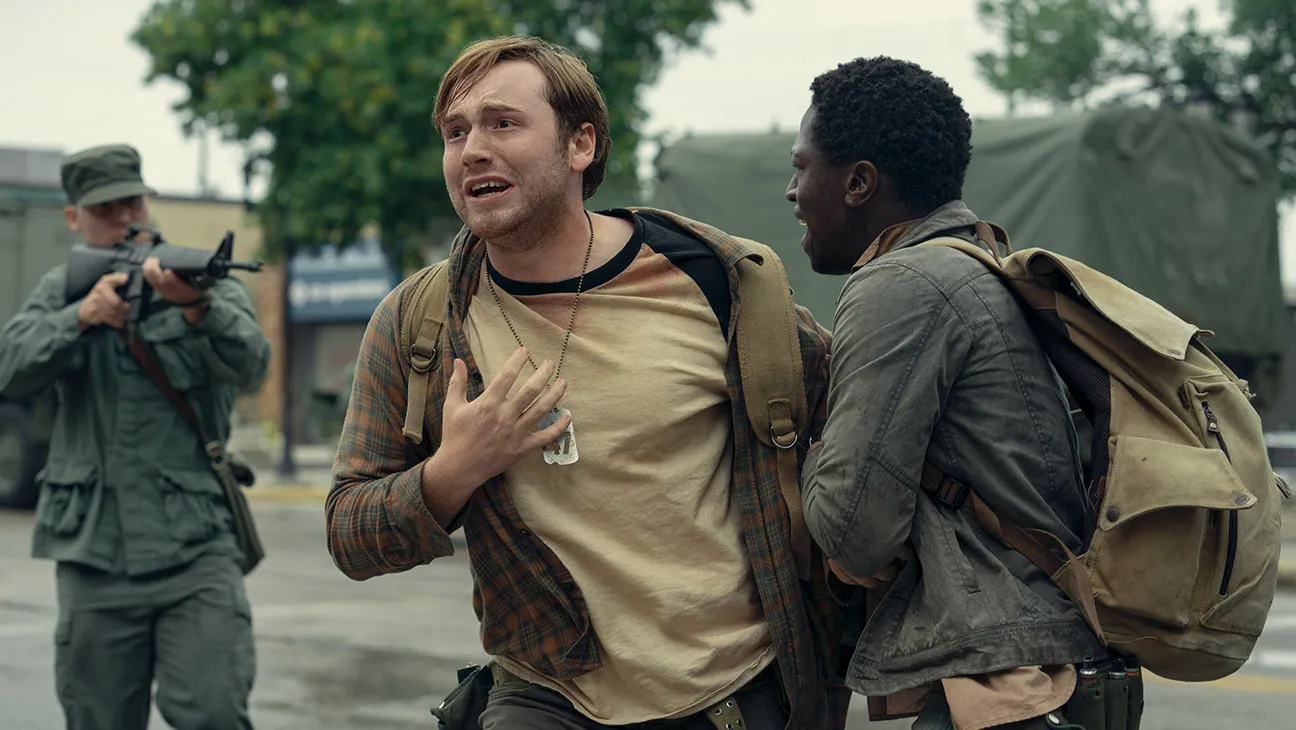
Francis Lawrence turns King’s most nihilistic novel into a relentless march toward despair—and that’s exactly the point
There’s something perversely refreshing about a studio film that refuses to offer hope. “The Long Walk,” Francis Lawrence’s adaptation of Stephen King’s 1979 novel (written under his Richard Bachman pseudonym), is a dystopian endurance test that never once winks at the audience or suggests things might work out fine. In our current landscape of sanitized YA adaptations, this commitment to bleakness feels almost revolutionary.
The premise is deceptively simple: 100 teenage boys must walk 400 miles without dropping below 4 mph. Three warnings, and you’re shot dead by military escorts. The last survivor wins everything. It’s “The Hunger Games” stripped of romance, rebellion, and redemption—just pure, grinding survival horror disguised as a coming-of-age story.
A Walk Through American Dystopia
Set in a post-Vietnam alternate America where authoritarian control has replaced democracy, “The Long Walk” uses its deadly competition as a magnifying glass for state-sanctioned violence. The regime has convinced families that this annual slaughter serves as both entertainment and a cure for youth “laziness”—a propaganda victory that would make Orwell nod in grim recognition.
Mark Hamill appears as The Major, the sunglasses-wearing official who cheerfully announces each death over a megaphone. It’s a chilling performance precisely because Hamill plays it without obvious menace—just bureaucratic efficiency with a smile. His presence transforms each execution into administrative routine, making the horror feel mundane and therefore more terrifying.
Cooper Hoffman Carries the Weight
Cooper Hoffman anchors the film as Ray Garraty, contestant #47, bringing a quiet intensity that recalls his father Philip Seymour Hoffman’s ability to convey internal turmoil through subtle physical acting. Ray’s backstory—his father was disappeared by the regime for spreading “subversive” philosophy—gives the character philosophical weight without turning him into a speechifying hero.
The film’s most effective moments come from Ray’s growing bonds with fellow walkers, particularly Peter McVries (David Jonsson), whose cocky exterior gradually reveals deeper vulnerabilities. Their friendship develops naturally against the backdrop of systematic elimination, making their inevitable separation all the more devastating.
Visual Restraint Serves the Story
Cinematographer Jo Willems chooses visual restraint over spectacle, keeping the camera close to the walkers and avoiding sweeping helicopter shots that might romanticize their journey. The dustbowl aesthetic evokes Depression-era photography, grounding the dystopian premise in recognizable American imagery.
This unfussy approach extends to the violence. While the film doesn’t shy away from showing deaths, the CGI blood feels intentionally artificial—a choice that emphasizes the game-show artificiality of the entire competition rather than wallowing in gore.
The Ensemble Finds Humanity in Horror
The supporting cast creates distinct personalities despite limited screen time. Charlie Plummer delivers a genuinely unsettling performance as Gary, a manipulative contestant who psychologically torments others into elimination. Joshua Odjick, Garrett Wareing, and Tut Nyuot each carve out memorable moments that make their eventual deaths feel genuinely tragic rather than just plot mechanics.
Screenwriter JT Mollner (fresh off the twisted brilliance of “Strange Darling”) deserves credit for avoiding the novel’s most heavy-handed philosophical discussions while preserving its intellectual underpinnings. References to Kierkegaard and Nietzsche feel organic rather than pretentious, emerging naturally from Ray’s educated background.
When the Walk Becomes Repetitive
The film’s commitment to its premise becomes both strength and weakness. Like the walk itself, the narrative grows repetitive by design—but that doesn’t make the repetition less taxing for viewers. Long stretches focus solely on the walking, with deaths punctuating increasingly similar conversations about motivation, fear, and survival.
The political messaging, while relevant, lacks subtlety. The finale’s use of “America the Beautiful” over images of state violence hits with sledgehammer force rather than scalpel precision. It’s effective but hardly nuanced, especially compared to the book’s more ambiguous conclusion.
A Contemporary “They Shoot Horses, Don’t They?”
“The Long Walk” most closely resembles Sydney Pollack’s 1969 depression-era marathon “They Shoot Horses, Don’t They?”—another film about entertainment built on human suffering. Both movies understand that dystopia doesn’t require alien invasions or fantastical technology; sometimes it just takes ordinary people convinced to watch others destroy themselves for prizes.
The film works as both period piece and contemporary warning. Its 1970s setting feels deliberately chosen to evoke American’s post-Vietnam disillusionment, but the themes of state violence, propaganda, and spectacularized death resonate powerfully with current anxieties about authoritarian creep.
The Anti-YA Adaptation
Perhaps “The Long Walk’s” greatest achievement is its refusal to function as typical YA fare. There’s no chosen one, no romantic subplot, no rebellion that changes everything. Just kids dying for adult entertainment while families cheer from the sidelines. It’s a coming-of-age story where coming of age means accepting that the world is fundamentally broken.
Cooper Hoffman’s performance particularly benefits from this approach. Rather than transforming into a heroic leader, Ray simply endures—and that endurance becomes its own form of quiet resistance against a system designed to break him.
A Grim March Worth Taking
“The Long Walk” succeeds by honoring its source material’s uncompromising vision. This isn’t entertainment that coddles or comforts; it’s a sustained examination of how societies normalize violence and dress up cruelty as competition. The film’s refusal to offer easy answers or uplifting conclusions feels almost punk rock in today’s marketplace.
Francis Lawrence has crafted a dystopian thriller that trusts its audience to handle unrelenting bleakness. In doing so, he’s created something increasingly rare: a studio film with genuine bite. “The Long Walk” doesn’t tell you anything particularly new about American authoritarianism, but it forces you to sit with that knowledge for 90 relentless minutes.
That sustained discomfort is precisely the point. Sometimes the most important stories are the ones that refuse to let you look away.