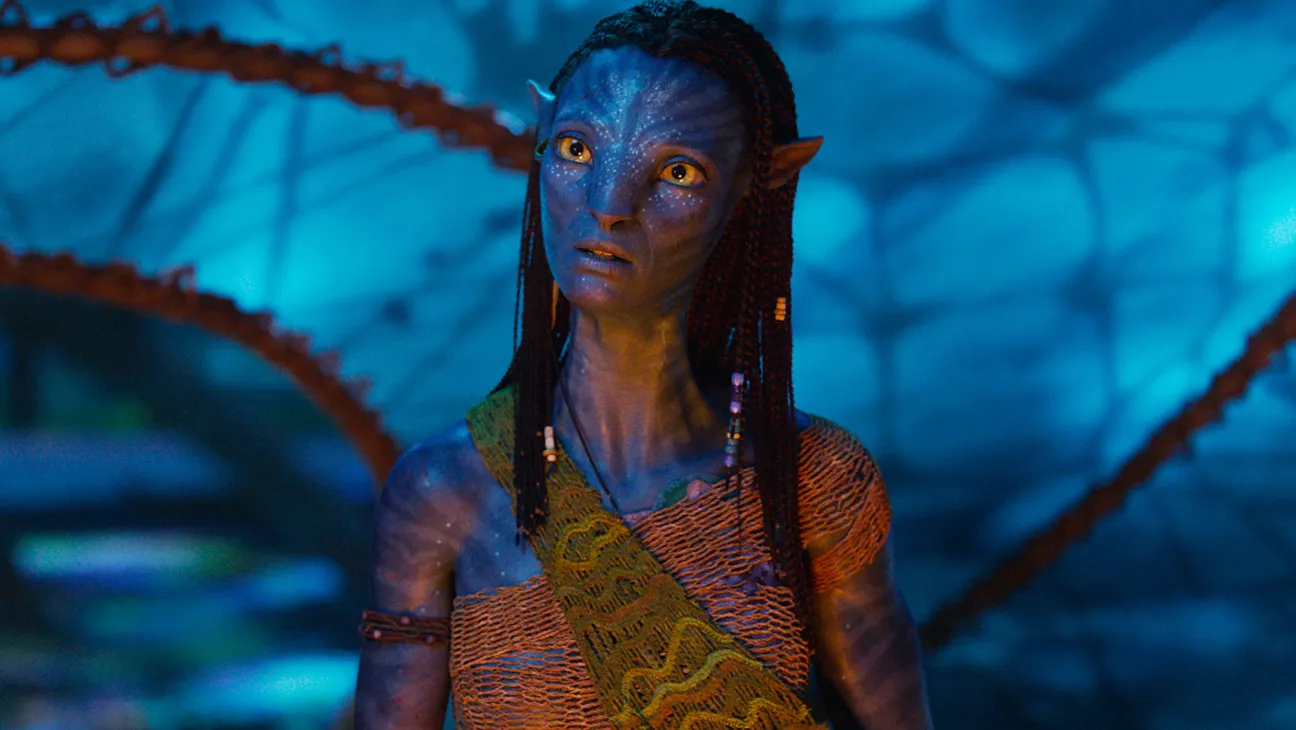
As James Cameron’s latest entry in the “Avatar” franchise prepares for its December 19 release, star Zoe Saldaña is opening up about why “Avatar: Fire and Ash” resonates with our current moment in ways that go far beyond stunning visual effects and fantastical world-building.
In an exclusive interview with CBR’s Grae Drake, Saldaña—who reprises her role as Neytiri—discussed the emotional depth and political relevance of the third installment, which arrives three years after 2022’s “Avatar: The Way of Water.”
The Long Journey to Pandora
When asked how these films “keep getting more timely, more gorgeous,” Saldaña acknowledged both the passage of time and Cameron’s uncompromising dedication to his vision.
“I feel like I’ve gone somewhere. A lot has happened,” she said. “It takes a long time to shoot these films, and the level of dedication that Jim [Cameron] has—he compels us all to be a part of something even though we have to wait for it.”
That wait appears to be worth it. Saldaña revealed she’d seen the final version of “Fire and Ash” just two days before the interview, and the experience left her profoundly moved.
The Weight of Loss
“What we were experiencing was so powerful,” she said. “The sense of loss, the experience of losing, and especially bearing a child, is unthinkable. It’s unimaginable.”
Saldaña described shooting emotionally devastating scenes alongside Sam Worthington, who plays Jake Sully. “I had Sam next to me, going through it with me, and me going through it with him. Because it was also—he, as Jake, as a father, lost something so dear to him, and Jim as well.”
She credited Cameron with creating “the safety net for us to be able to allow ourselves to go there for the sake of Neytiri and Jake.”
The Resilience of the Sully Children
While “Fire and Ash” deals with grief and loss, Saldaña emphasized that it’s ultimately about resilience and family bonds.
“What we’re going to discover in this film is the resilience of the Sully children, how much they are inherently Neytiri and Jake,” she explained. “They’ve been raising them well, and these kids will guide their parents back to each other, to the family, to the purpose of Eywa, to all of it.”
This generational shift—with the children becoming guides for their grieving parents—adds emotional complexity that distinguishes “Fire and Ash” from typical blockbuster sequels.
Redefining Privilege in a World of Conflict
Saldaña didn’t shy away from discussing the film’s political dimensions, even as she acknowledged the sensitivity of the topic.
“I don’t want to make this a political conversation, but we all are understanding our privilege,” she said. “If you are in a position where you get to wake up every day and go to work peacefully and come home in one piece, and your children come home from school and their lives were not threatened, and your wife or your husband comes home and they are okay, and your parents are okay, then you are privileged.”
This redefinition of privilege—moving beyond wealth and material success to simply being able to live without violence—feels particularly resonant in 2025.
“Privilege is no longer money and richness and success and the collection of material things,” Saldaña continued. “It’s getting to live another day alive without experiencing some kind of conflict that has nothing to do with you and yet completely destroys your world and your life.”
A Broken Heart and the Power of Stories
Saldaña’s connection to global suffering is personal and ongoing.
“We are seeing that around the world,” she said. “My heart goes out to all of it, and I feel like I wake up every day with a broken heart. And if it wasn’t for the fact that I get to be a part of stories that inspire people, that make people feel seen, that make people feel that they matter, that inspire people to heal…”
This admission—that participating in meaningful storytelling helps Saldaña process her own grief about global conflicts—speaks to why “Avatar” continues resonating beyond its impressive box office returns. These films aren’t just spectacle; they’re processing trauma, loss, and resilience through the lens of science fiction.
Hope for Collective Healing
Saldaña’s hopes for “Fire and Ash” extend beyond entertaining audiences. She wants the film to create shared experiences that remind us of our common humanity.
“My hope for ‘Fire and Ash’ is that families are able to go together, people are able to go together and connect as strangers in a big room in an IMAX theater and watch it and laugh and cry and be taken for an adventure,” she said. “People are inspired to still continue believing in each other, because I think it’s important.”
In an era of increasing isolation and polarization, the idea of strangers gathering in a theater to collectively experience a story about family, loss, and resilience carries weight beyond typical movie marketing.
The Bigger Picture
The “Avatar” franchise has always worn its politics on its sleeve—stories about indigenous peoples fighting against colonizers with superior technology aren’t exactly subtle. But what Saldaña describes suggests “Fire and Ash” is engaging with these themes on a more intimate, emotionally raw level.
The focus on loss, on what it means to simply survive another day without violence, on children guiding traumatized parents back to wholeness—these aren’t abstract political statements. They’re deeply human experiences that, unfortunately, remain relevant for millions of people around the world.
Cameron has always been ambitious about what blockbuster filmmaking can achieve. With “Fire and Ash,” it seems he’s aiming not just to entertain but to create space for collective processing of grief and an affirmation of human resilience.
Whether the film succeeds in that lofty goal, audiences will discover when “Avatar: Fire and Ash” arrives in theaters on December 19. But Saldaña’s passionate defense of its relevance suggests Cameron has once again created something that aspires to be more than just another sequel.
Sometimes, the most fantastical stories about blue aliens on distant moons are the ones that help us make sense of our own world.