The Burden of Standing Out in a Crowded Field
A world where anthropomorphic animals live their lives much like our own is such a perennial setting for animation that Goat is opening while the very well-received—and insanely financially successful—Zootopia 2 is still packing theaters. And it’s not even the only animated animal film with a basketball focus, given there are two animation/live-action hybrid Space Jam movies already in existence. So with that considerable burden on its back, it’s perhaps even more gratifying that Goat turns out to be an entertaining, lively, and terrifically animated film that stands on its own merits.
In a landscape where talking animal movies have become almost as common as superhero films, Goat could have easily disappeared into the background noise. Instead, it finds ways to distinguish itself through sheer craftsmanship and heart—even when following a story template we could probably recite in our sleep.
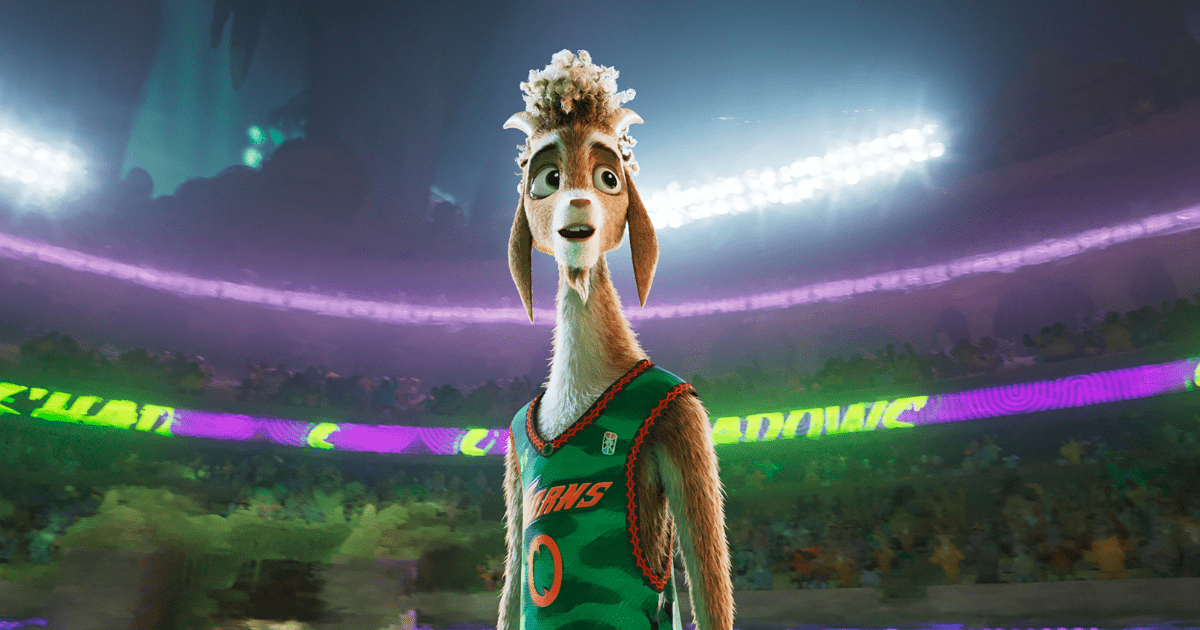
Our hero here is Will Harris (voiced by Stranger Things‘ Caleb McLaughlin), a young goat who is not just a massive fan of roarball—this film’s adorably straightforward name for basketball—but also dreams of making it as a professional player himself, despite being one of the so-called “smalls.” These are animals who, quite literally, don’t seem to be built for the game in a world where elephants, rhinos, and giraffes dominate the sport with their size and natural advantages.
But after videos of Will go viral when he plays a streetball game against an actual pro—Aaron Pierre’s amusingly named horse character, Mane Attraction (yes, really)—and more than holds his own with impressive moves, Will finds himself recruited to his beloved hometown team, the Thorns. Even though he’s basically been hired as a publicity stunt by team owner Flo (Jenifer Lewis, bringing her signature sass), with no one seriously intending for him to ever actually play in a real game, Will sees this as his shot at the big time.
Playing It Safe (And That’s Okay)
Goat plays things very safe on the story side, and I’m going to be upfront about that. Is there a point where circumstances lead Will to be called off the bench and enter a crucial game? Does he then show just how talented he actually is to the skeptical fans? Can he and his teammates work through their personal issues and past failures to actually become a cohesive unit? Who’s to say!? (We all know the answers.)
Yes, this is fundamentally a kids and family animated movie, but we’ve still seen many in recent years with some genuinely interesting and surprising storylines or bold plot points—Spider-Man: Into the Spider-Verse radically reinvented superhero storytelling, The Mitchells vs. The Machines found fresh angles on family dynamics, and even Zootopia tackled systemic prejudice in ways that surprised audiences. Yet there’s something to be said for telling a predictable and traditional story exceptionally well, and while Goat is going down a rather safe narrative path, there’s a tremendous amount of wit, charm, and warmth to be found in the way that writers Aaron Buchsbaum and Teddy Riley (working from a story by Nicolas Curcio and Peter Chiarelli), director Tyree Dillihay, and the entire animation team take us along on Will’s journey.
Sometimes you don’t need to reinvent the wheel—you just need to build a really excellent wheel and make sure it rolls smoothly. Goat understands this principle and commits to it fully.
Gabrielle Union’s Jett Steals the Show
Part of what elevates Goat beyond standard sports movie fare is accomplished by giving the film a near co-lead in the form of Thorns team captain Jett Fillmore (Gabrielle Union), a black panther who’s a roarball legend but now facing the harsh reality of getting older and criticism that she’s long past her prime. There are numerous strong scenes for Jett on her own—watching her struggle with her declining abilities and relevance—and also between her and Will, as she begins to bond with him despite her initial dismissive and even hostile nature towards her young new teammate. The film gives the two a well-developed and properly emotional rapport that feels earned rather than rushed.
McLaughlin and Union both bring substantial heart to their vocal performances, with McLaughlin capturing Will’s youthful optimism and determination without making him annoyingly naive. Union adds exactly the right touch of world-weary cynicism (and a subtle undercurrent of narcissism) to Jett, who’s spent years dominating the game in a way that’s made her a legitimately bad teammate. She’s not a villain, but she’s not entirely likable either—at least not initially—and that complexity makes her arc more satisfying.
And they’re aided by a genuinely strong ensemble of supporting players comprising their teammates, including Nicola Coughlan (Bridgerton) as the ostrich Olivia Burke, David Harbour (Stranger Things) as the rhino Archie Everhardt, and Nick Kroll as Komodo dragon Modo Olachenko, along with Patton Oswalt as their coach, proboscis monkey Dennis Cooper. All of them get some legitimately funny spotlight moments that feel organic rather than forced.
It was amusing, but made perfect sense, to learn via the closing credits that the only one of these characters that never really pops comedically or feels especially interesting vocally—the Thorns’ giraffe player, Lenny Williamson—was the one voiced by the non-actor in the cast, NBA star Stephen Curry, who is one of Goat‘s producers. Curry is obviously a basketball legend, but voice acting is its own skill set, and it shows here.
Where Goat Truly Transcends: The Animation
But where Goat truly shines and definitively stands out from the competition is in its spectacular animation. Sony Pictures Animation has put out a lot of impressive—and very impressive-looking—films in recent years, including the revolutionary Spider-Man: Into the Spider-Verse and its equally stunning sequel, the delightfully chaotic The Mitchells vs. The Machines, and the underrated K-Pop Demon Hunters. The work of Sony’s extremely talented designers and animators continues to impress with Goat, which boasts some genuinely fantastic visuals throughout that deserve to be seen on the biggest screen possible.
Will and his friends live in the part of their world called Vineland, which is absolutely packed with wonderful environmental details that reward multiple viewings. Rather than simply having these animals live in a town just like our own with some animal-specific modifications, or doing something cute and old-school cartoon-esque like putting a regular-looking house up in a tree, Vineland has a distinctive aesthetic all of its own that feels fresh. It’s as if branches, trees, bushes, and foliage were actively and organically intertwined with the architecture of our world during construction. The park court Will plays at has massive branches naturally growing around the hoop, while leaves line the walls of restaurants and homes as if they’re part of the building materials. It’s a brilliant mashup of things that look intentionally built and grown simultaneously with nature, and it feels like a vibrant and genuinely creative spin on this sort of “wild animals in suburbia” animated scenario we’ve seen countless times.
Basketball Courts You Won’t Believe
And then there are the other lands the team travels to for their away games, and specifically the courts they play on—which is where Goat really flexes its creative muscles. Because while roarball’s rules are pretty much one-to-one with basketball as we know it, when it comes to the environments these teams play in, things get dramatically trickier and outright dangerous in ways that make NBA courts look boring by comparison.
One court is covered in stalagmites violently bursting forth from the ground that players must navigate around, turning every drive to the basket into an obstacle course. Another is covered in ice that begins to crack and separate beneath the feet of the competing teams, revealing the freezing water below and forcing players to leap between ice floes, even as the game continues without pause. And then there’s the game that looks like what would happen if Darth Vader decided to set up a basketball court on Mustafar, with flowing magma beneath the volcanic rock the teams are playing on, adding a suitably operatic and intense vibe to what’s essentially the championship game. It’s all awesome to behold, with high-energy, kinetic motion to the games themselves that genuinely helps further invest you in Will and his teammates in classic underdog fashion.
These aren’t just visual flourishes for the sake of spectacle—though they certainly are spectacular. They serve the story by making each game feel genuinely distinct and by raising the stakes in increasingly creative ways. You find yourself genuinely worried for these characters’ safety in a way you normally wouldn’t in an animated sports movie.
The Joy of Animals Being Animals
Goat also has tremendous fun with the idea that these characters truly are animals in ways that matter, not just people who happen to look like animals. While they walk upright on two legs and use their hands like humans do, we quickly learn that these goats, horses, panthers, and other creatures also still run on all fours when the situation calls for maximum speed. And lots of clever sight gags come from how they still act and behave as we might expect them to in our world in certain scenarios—from how Jett drinks water from a bowl like a cat (complete with that distinctive lapping motion), to the easily panicked Olivia carrying a bucket of sand with her that she can literally bury her head in when she’s freaking out.
(Yes, ostriches don’t actually bury their heads in sand in real life; it just can look that way when they’re feeding. But a good gag based on a common animal misconception is still a legitimately good gag, and this film uses it to great comedic effect.)
These details could have been lazy shortcuts, but instead they’re deployed with creativity and care, reminding us that the filmmakers are thinking about their characters as fully realized beings rather than just vehicles for a sports story.
The Verdict: Predictable But Polished
Goat tells a basic and admittedly familiar underdog sports story—you’ve seen this narrative arc in everything from Rocky to The Mighty Ducks to Cool Runnings—but it does so in a genuinely warm-hearted and endearing manner, with likable characters you can easily root for. Even if adults in the audience can easily predict exactly how things will play out for them, there’s enough craft and heart in the execution to make the journey enjoyable rather than tedious.
And where Goat really soars—pun not intended but happily accepted—is on the animation front, with some especially clever and dynamic visuals that help make the centerpiece games feel genuinely special and exciting. These sequences allow this world of anthropomorphic animals to feel unique and lived-in, even with plenty of competition on that front from other recent releases. The environmental design of Vineland and the various courts is imaginative enough that it could inspire its own theme park attraction, and the character animation is fluid and expressive in ways that bring real personality to these animal athletes.
For families looking for quality entertainment that won’t bore the adults while keeping kids engaged, Goat is an easy recommendation. It won’t change your life or revolutionize animation, but it will give you a solidly entertaining time at the movies with some genuinely beautiful visuals to appreciate. Sometimes that’s exactly what you need—and Goat delivers it with style and heart.
Rating: 7.5/10
Have you seen Goat yet? How do you think it compares to other recent animated animal sports movies? And which of those creative basketball courts would you most want to play on (or most want to avoid)? Let us know your thoughts in the comments below!