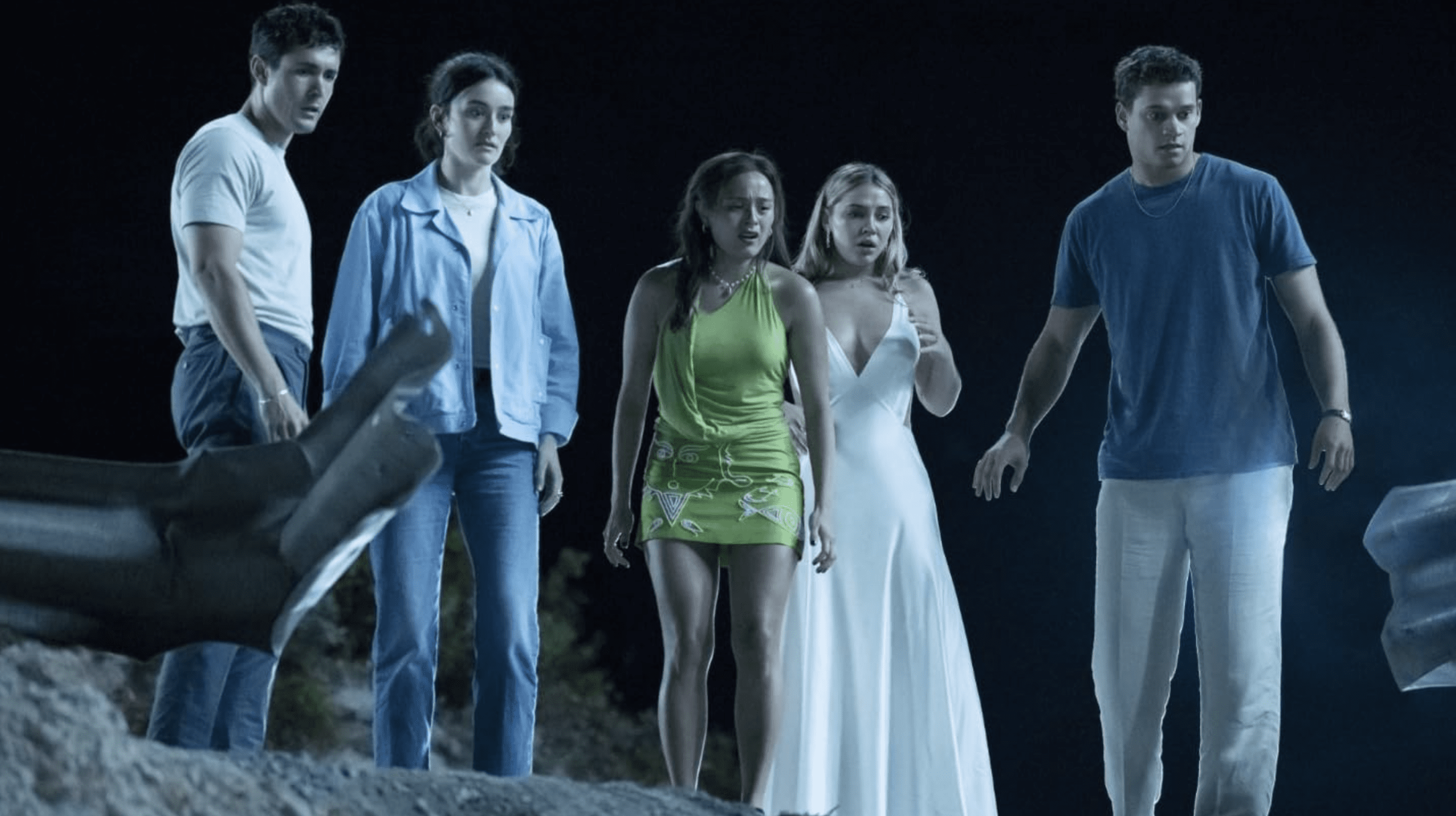
But was the Fisherman’s return to Southport worth the wait?
Sometimes the horror genre gives us exactly what we need, even if it’s not what we expected to want. Jennifer Kaytin Robinson’s 2025 take on I Know What You Did Last Summer arrives at a moment when audiences are craving the comfort food equivalent of scary movies—unapologetically campy, delightfully self-aware, and refreshingly honest about its own limitations. This isn’t high art, and it never pretends to be. Instead, it’s a love letter to the kind of slasher that knows how to have fun with its own ridiculousness.

The film walks the tightrope between remake and legacy sequel with surprising grace. When Ava (Chase Sui Wonders) returns to Southport for her best friend Danica’s (Madelyn Cline) wedding, she’s pulled back into the same web of secrets and lies that ensnared Julie James nearly three decades ago. After a Fourth of July night goes tragically wrong—involving a car crash, a pact of silence, and that inevitable mysterious note—the Fisherman returns to collect his due.
What Robinson and co-writers Sam Lansky understand is that modern audiences come to a movie like this with built-in expectations. We want the jump scares, the “slicker” references (and boy, do we get them), and the satisfying logic-defying teleportation skills of our killer. The film delivers on every single one of these promises without shame or irony-poisoned smugness.

The decision to bring back Jennifer Love Hewitt and Freddie Prinze Jr. as Julie and Ray proves inspired, not just for nostalgia points but for the weight their presence adds to the proceedings. Hewitt, in particular, captures Julie’s hard-won wisdom and hair-trigger paranoia perfectly—she’s someone who’s learned that sometimes you have to strike first and ask questions later. Prinze, while given less meaty material to work with, brings a weary gravitas that grounds the younger cast’s more frantic energy.

Speaking of that younger cast, they’re exactly what this kind of movie needs. Wonders and Cline commit fully to the heightened reality of slasher logic, while Jonah Hauer-King and Sarah Pidgeon round out a group that feels authentically dysfunctional rather than artificially constructed. Tyriq Weathers deserves special mention for bringing both charm and complexity to Teddy, making him someone you genuinely can’t decide whether to root for or against.
Robinson’s greatest strength as a director lies in her tonal control. She understands that camp works best when it’s played straight, and that the most effective scares come from characters we actually care about being put in genuine jeopardy. Yes, the Fisherman still appears out of nowhere with supernatural stealth, and yes, the sound design occasionally relies on LOUD NOISES over subtle tension-building. But these aren’t bugs—they’re features that fans of the subgenre actively expect and enjoy.
The script smartly updates the original’s setup in ways that acknowledge how much the world has changed since 1997. Police involvement feels more realistic, social media creates new complications, and the characters’ relationships reflect a more contemporary understanding of sexuality and identity. Ava’s post-breakup exploration of her bisexuality isn’t treated as trauma response or character flaw—it’s just part of who she is, which feels refreshingly normal.

Where the film occasionally stumbles is in its unwillingness to dig deeper into the more provocative themes it introduces. The corruption angle involving Billy Campbell’s Grant Spencer works as a plot device but doesn’t quite develop into the systematic critique it could be. Similarly, the class dynamics that gave the original some of its bite are mostly smoothed over here, with everyone seeming to have unlimited resources to deal with their problems.
But these criticisms feel almost beside the point when evaluating what I Know What You Did Last Summer set out to accomplish. This is comfort horror at its most effective—familiar enough to feel like coming home, fresh enough to justify the return trip. Robinson has created something that works both as nostalgic throwback and contemporary entertainment, no small feat in an era when most reboots feel obligatory rather than inspired.

The film’s self-awareness never tips over into self-parody, and its commitment to genre conventions feels celebratory rather than mocking. When the Fisherman brandishes that oversized hook, when someone inevitably investigates a suspicious noise alone, when the final girl makes her last stand—these moments land because everyone involved, from cast to crew, clearly loves this type of storytelling.
In a landscape dominated by elevated horror and intellectual genre exercises, there’s something genuinely refreshing about a movie that just wants to deliver effective scares, memorable characters, and a killer in a rain slicker. I Know What You Did Last Summer succeeds by knowing exactly what it is and delivering that experience with skill and enthusiasm.
Is it the best horror movie of the year? Probably not. Is it exactly the kind of unpretentious, entertaining genre filmmaking we need more of? Absolutely. Sometimes the most honest thing a horror movie can do is promise you a good time and then deliver on that promise without apology.

Robinson and her team have created something that feels both nostalgic and contemporary, familiar yet fresh. It’s a reminder that not every horror movie needs to reinvent the wheel—sometimes it just needs to make sure the wheel is perfectly round and rolls exactly where you want it to go.
Rating: ★★★☆☆
I Know What You Did Last Summer knows exactly what it wants to be and achieves those modest but satisfying goals with style. For fans of campy slashers and anyone looking for an entertaining summer scare, the Fisherman’s return to Southport is well worth the wait.