Holly Wheeler’s Favorite Book Isn’t Just an Easter Egg—It’s the Blueprint for the Final Battle.
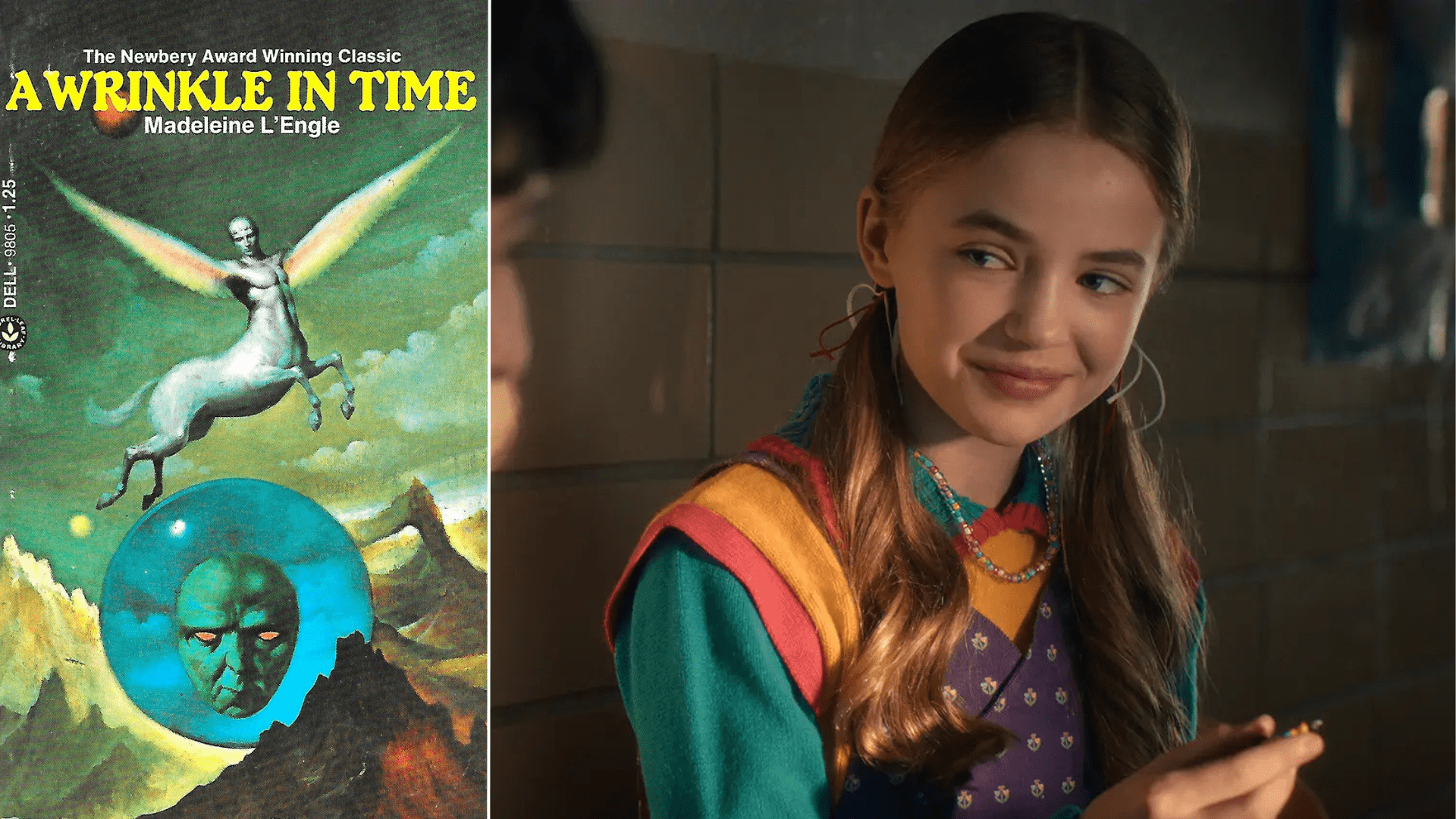
Like many of you, we’ve been completely immersed in Stranger Things since 2016. The show’s magic lies not just in the horror and the mystery, but in its pitch-perfect ’80s nostalgia and, crucially, its use of literary and fantasy archetypes. We all know the importance of Dungeons & Dragons, but Season 5 just introduced a new, powerful piece of the puzzle: Madeleine L’Engle’s 1962 sci-fi fantasy novel, A Wrinkle in Time.
The following contains spoilers for Stranger Things season 5, volume 1
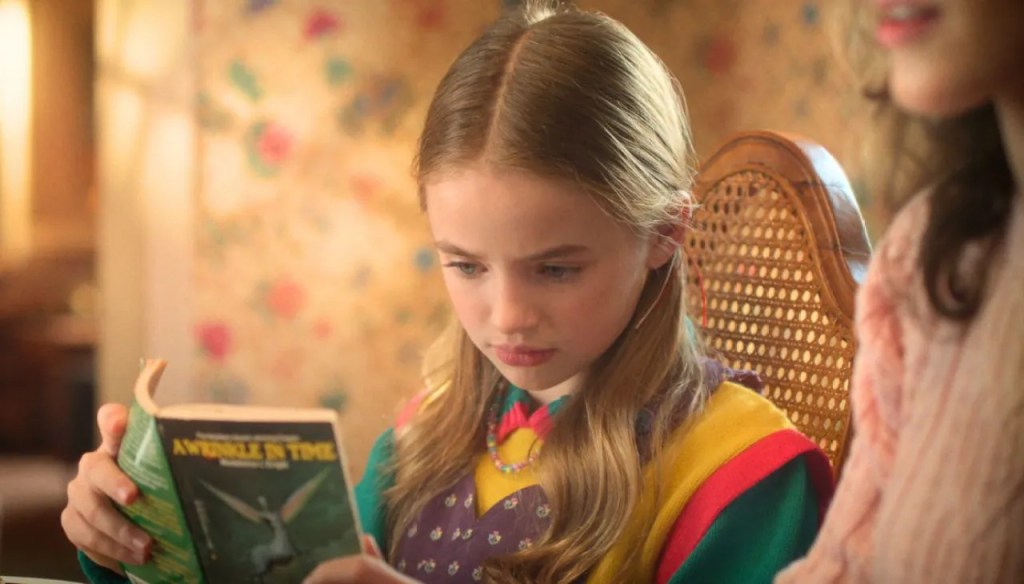
In the season premiere, we see the novel in the hands of Holly Wheeler, Nancy and Mike’s youngest sister. As the Vecna-fueled chaos descends upon the Wheeler home, Holly begins to use the book’s language to make sense of her horrific situation.
To fans of the novel, Holly’s references aren’t just cute set dressing. They point directly to the themes, plot points, and even the final strategy the Hawkins gang might use to defeat the ultimate evil. Let’s break down the two major A Wrinkle in Time connections and what they mean for the end of Stranger Things.
The Mystery of Mr. Whatsit
The most immediate and unnerving literary nod comes from the name Holly gives her “imaginary friend”: Mr. Whatsit.
In the first episodes, others dismiss “Mr. Whatsit” as Holly’s coping mechanism, but we know better. He’s a nattily-dressed man in a tan suit who treats Holly kindly. It’s an obvious inversion of the novel’s character, Mrs. Whatsit, a powerful witch/interdimensional being who arrives in a “dark and stormy night” but radiates kindness. Mrs. Whatsit guides Meg Murry and her friends to find her missing scientist father and helps the children realize their own worth.
The Truth About Holly’s New Friend
We soon learn that “Mr. Whatsit” is none other than Henry Creel, the man who becomes Vecna. He appears to Holly in a kinder, more welcoming form, offering to take her to a kind and loving place. After the Demogorgon attack, Holly is kidnapped and taken into a reality based on Creel’s past—a welcoming house where she can do anything she wants, except go into the woods.
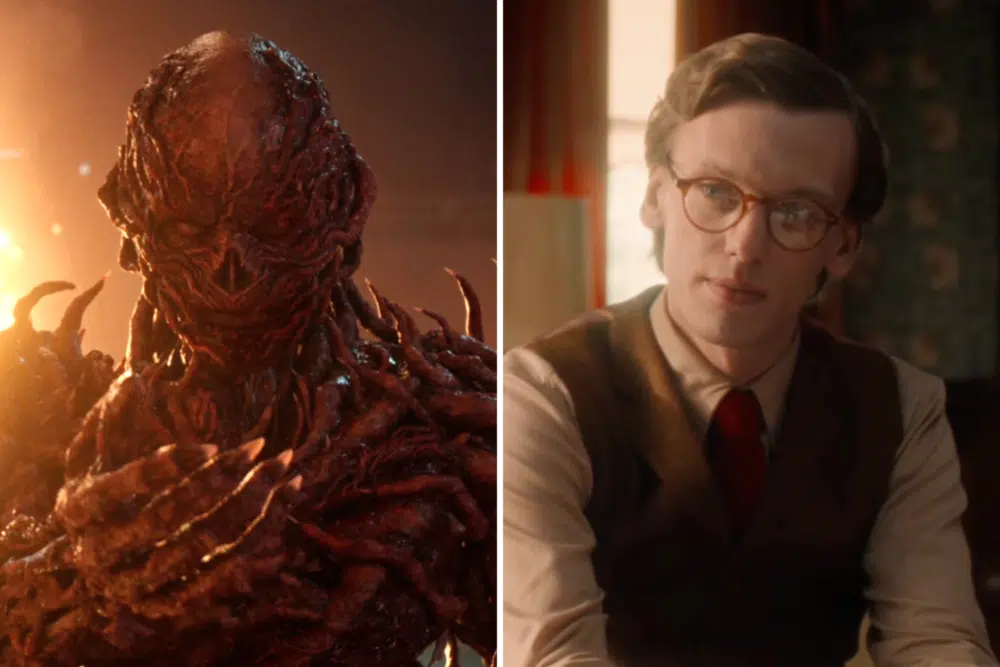
On the surface, this looks like a fatal mistake on Holly’s part. Did her insistence on seeing a kind, magical creature based on her favorite character blind her to the monster? Vecna certainly thinks so, claiming he hunts children because they’re easy to manipulate.
Could Holly Be Tapping into Henry’s Goodness?
Here’s the fan theory twist: Previous seasons have hinted that Creel and Vecna may be distinct, warped personalities within the same person. Could some sliver of goodness still reside in the Henry Creel identity?
By calling him Mr. Whatsit, Holly may not be making a fatal mistake; she may be calling forth that lingering goodness! She is labeling the powerful, odd, and crucial figure in her life after an ultimately good figure from her favorite book. And if Mrs. Whatsit taught Meg anything, it’s that children can and must stand up to the forces of darkness. Holly will need that lesson in the Upside Down.
Camazotz: The Planet of Oppressive Conformity
The second, and perhaps most plot-relevant, connection comes after Holly eventually ventures into the forbidden woods and reunites with Max Mayfield. Max explains how Vecna controls the Upside Down, forcing everything in his own horrific image.
This perfectly clicks for Holly, who immediately compares it to a specific location in L’Engle’s novel: Camazotz.
Vecna’s World is IT’s World
In A Wrinkle in Time, Camazotz is the climax destination. It initially appears as a dull, perfect suburb of identical houses, but the children soon realize every house has a child bouncing a red rubber ball in exact, perfect rhythm. That rhythm matches IT, the novel’s antagonist, a pulsating, disembodied brain at the center of the world. IT represents oppressive conformity, choking out individuality and beauty.
By identifying Vecna’s domain as Camazotz, Holly acknowledges the monster’s deepest desire: to corrupt the world until it conforms entirely to his will.
Thematic Blueprint for the Final Season
The Camazotz connection has powerful thematic ties for Stranger Things‘s final season, which is deeply concerned with the theme of self-acceptance and individuality.
L’Engle’s protagonists—Meg, Charles Wallace, and Calvin—were outcasts who couldn’t conform, making them the perfect warriors against IT.
Similarly, the kids of Hawkins—the freaks and geeks, the gay characters, the telekinetic outcast—resist Vecna best when they are simply allowed to be their authentic selves.
This theme is highlighted by Robin’s moving monologue about coming out to herself and how the realization felt “like flying”—a metaphor that resonates with A Wrinkle in Time readers, as Mrs. Whatsit literally transforms into a winged creature to carry the children across the sky.
Like Meg, Charles Wallace, and Calvin, the Hawkins party’s strength isn’t in conforming to military ideals or social expectations; it’s in embracing the very traits that make them different.
The Sonnet of Hawkins
Ultimately, the A Wrinkle in Time references are brilliant because they provide a structure without dictating the plot. Remember Mrs. Whatsit’s quote about the sonnet?
“You’re given the form, but you have to write the sonnet yourself… What you say is completely up to you.”
L’Engle gave us a form for a fantasy sci-fi battle against oppressive evil. The Duffer Brothers have taken that form—the concept of nonconformity beating conformity, of love and individuality defeating a cosmic brain—and they are now writing the final lines of the Stranger Things sonnet.
The battle against Vecna/IT is coming, and it will be fought not just with fire and telekinesis, but with acceptance, love, and the beautiful chaos of human individuality.
Stranger Things Season 5, Volume 1 is currently streaming on Netflix. Volume 2 (Episodes 5-7) will release on December 25, 2025, and Volume 3 (the finale, Episode 8) will be released on December 31, 2025. Both are scheduled to drop at 8 p.m. ET/5 p.m. PT.