Clint Bentley’s Train Dreams is a film that moves like a river—slow, steady, and deceptively powerful. Adapted from Denis Johnson’s 2011 novella, this is cinema that asks for patience in an age that rarely rewards it. On paper, it might seem like a tough sell for contemporary audiences: light on explosive plot developments, anchored by a protagonist who speaks more through silence than words, and structured as an episodic journey across decades rather than a propulsive narrative sprint. But this is precisely the point, and Bentley’s execution is nothing short of remarkable. Train Dreams is a tender meditation on one man’s existence, finding profound meaning in the small, significant moments that comprise a life lived largely unseen.
Joel Edgerton delivers what may be career-defining work as Robert Grainier, a logger and railroad laborer surviving day by day in the early 20th century Pacific Northwest. He’s a man of few words by design, but Bentley’s film reveals the depths beneath that quiet exterior—the costs and consequences of American progress as witnessed through the eyes of someone history would otherwise forget. We follow Grainier from humble beginnings through formative experiences: his complicity in the death of a Chinese coworker at the hands of racist colleagues, the building of home and family with his wife and daughter, and his search for meaning in later years after tragedy redirects the trajectory he thought was set.
Edgerton and Jones Anchor the Film’s Emotional Core
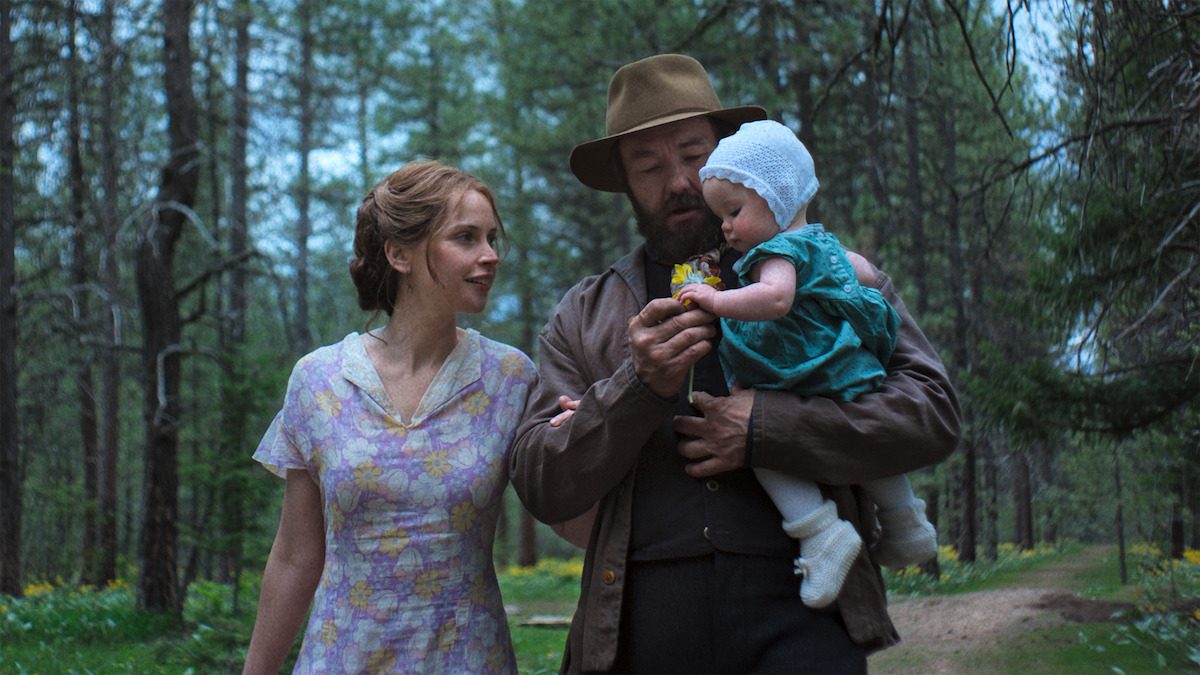
Edgerton has been a reliable presence in films for years, but his work here transcends competence and enters the realm of genuine artistry. He makes you believe completely that a man with little to say can possess great thoughts and even greater feelings. His performance is beautifully complemented by Felicity Jones as his wife Gladys, who despite her English origins feels entirely authentic as a woman carved from the American countryside. One of the film’s most memorable sequences finds the couple lying together beside a river near their home, simply existing in the beauty around them and treasuring the shared experience. The movie largely skips their courtship, but that time never feels absent—Bentley and his actors understand how to generate profound emotional investment with only a handful of carefully constructed scenes.
That economy of storytelling is one of Train Dreams’ most surprising achievements. At under two hours, the film feels far more expansive than its runtime suggests. Will Patton’s narration and Parker Laramie’s editing create seamless transitions between events, allowing audiences to feel the weight of years passing even when those years aren’t shown in full. Patton’s voice work is something of a minor miracle, avoiding the usual pitfalls of expository narration by never prescribing how we should feel about what unfolds. Instead, it reinforces the emotional tenor Bentley is cultivating. The narration suits the gentle, unhurried rhythm of the story and serves as another way the film honors the literary nature of its source material.
A Visual Poem Captured in Film
But film is fundamentally a visual medium, and Train Dreams is gorgeous by any measure. Calling Adolpho Veloso’s cinematography “painterly” might be too obvious, yet the word genuinely captures how the film renders the greens and browns of Washington state, where it was shot. It’s genuinely unfortunate that most viewers will experience this film exclusively on Netflix rather than on a theatrical screen. Comparisons to Terrence Malick’s work are inevitable given the film’s reverence for nature and abundance of magic hour compositions, but I was equally reminded of Thomas Vinterberg’s Far from the Madding Crowd or Terence Davies’ Sunset Song. All three films share Train Dreams’ embrace of pastoral literary conventions and use rural imagery to give characters depth through visual placement as much as through dialogue.
Train Dreams is a beautiful ode to the idea that our life stories matter even if only a handful of figures ever witnessed them.
Minor Stumbles Don’t Diminish the Achievement
This doesn’t mean every element lands perfectly. Some dialogue reaches for poetic profundity that feels unnecessary, and certain characters register as missed opportunities. Kerry Condon, so memorable in The Banshees of Inisherin, appears late in the film as a forestry services worker who shares a couple of brief interactions with Grainier before vanishing from the narrative entirely. There’s also a nighttime reveal that seems positioned to lead somewhere significant but ultimately doesn’t. Yet even with these minor setbacks, Bentley understands how to conclude his story, bringing Grainier’s journey full circle with an ode to the notion that our individual stories hold value regardless of how many people witnessed them.
Train Dreams proposes that history isn’t constructed from dates, places, triumphs, or defeats so much as it’s built from people—most of whom will never be remembered, but who lived nonetheless and were connected to the world around them. It’s an undeniably sentimental notion, but it feels earned because every creative choice in the film builds toward this conclusion. If more movies demonstrated this kind of patience with their storytelling, allowing impact to linger long after credits roll rather than evaporating immediately, perhaps a film like Train Dreams wouldn’t feel like such a singular, impressive achievement.
The Verdict
Train Dreams is a gentle but deeply affecting pastoral Western that chronicles a life lived across many years. Joel Edgerton and Felicity Jones are exceptional, Adolpho Veloso’s cinematography is stunning, and Clint Bentley’s direction demonstrates a level of care and consideration that feels remarkable for a filmmaker with so few features to his name. This is a film that trusts its audience to find meaning in quiet moments, and rewards that trust with something genuinely memorable.