In a shocking revelation that exposes Hollywood’s harsh realities, Alan Tudyk has disclosed why most audiences remain unaware of his starring role in the 2004 blockbuster “I, Robot”—and the reason will leave you questioning studio priorities.
The Performance That Was Too Good
Speaking candidly on the “Toon’d In with Jim Cummings” podcast, Tudyk revealed a stunning behind-the-scenes truth: he was completely erased from the film’s marketing campaign after test screenings showed audiences preferred his robot character Sonny over Will Smith’s lead detective.
“They were doing test audiences for the movie, and they score the characters in this kind of test screening,” Tudyk explained. “I got word back: ‘Alan, you are testing higher than Will Smith.’ And then I was gone. I was done. There was no publicity, and my name was not mentioned.”
The actor’s shock was palpable as he recounted the devastating news: “I was like, ‘Wait, nobody is going to know I’m in it!’ I put a lot into [that performance]. I had to move like a robot. At the time, I was very upset.”
A Hidden Star Performance
This revelation explains why countless moviegoers watched “I, Robot” without realizing they were witnessing Tudyk’s remarkable motion capture and voice performance as Sonny, the highly intelligent robot at the center of the mystery. His portrayal brought depth and humanity to what could have been a cold, mechanical character—apparently too successfully for the studio’s comfort.
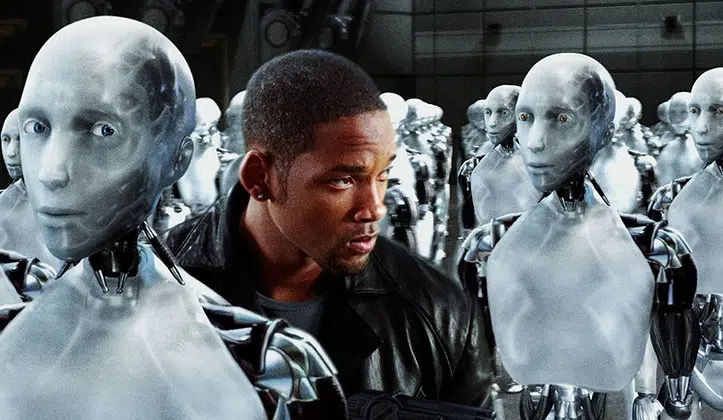
Director Alex Proyas’s sci-fi thriller, set in 2035 Chicago, follows Smith’s detective investigating the alleged suicide of a robotics company founder. When Smith’s character suspects that one of the corporation’s advanced robots—Tudyk’s Sonny—committed murder, the stage is set for a compelling human-versus-machine narrative that clearly resonated more with Tudyk’s nuanced performance than anticipated.
Motion Capture Pioneer
Tudyk’s work in “I, Robot” came during the early days of motion capture technology in Hollywood, when only characters like Jar Jar Binks in the “Star Wars” prequels and Gollum in “The Lord of the Rings” films had proven the technique’s potential. His innovative performance helped establish the foundation for what would become a revolutionary filmmaking tool.
The irony deepens when considering Tudyk’s later motion capture triumph as the beloved droid K-2SO in “Rogue One: A Star Wars Story,” a role he reprised in the Disney+ series “Andor.” That performance earned widespread acclaim and recognition—exactly what “I, Robot” denied him two decades earlier.
The Cost of Star Protection
This controversy illuminates the uncomfortable reality of Hollywood’s star system, where protecting a leading man’s ego and marketability can overshadow superior supporting performances. The decision to bury Tudyk’s contribution not only robbed him of deserved recognition but also deprived audiences of understanding the full creative achievement behind Sonny’s memorable character.
The supporting cast, including Bridget Moynahan, Bruce Greenwood, James Cromwell, and Chi McBride, all received standard promotional treatment—making Tudyk’s exclusion even more glaring.
A Legacy Finally Revealed
While Variety has reached out to Smith’s representatives for comment, Tudyk’s revelation stands as a testament to both his exceptional talent and the industry’s sometimes ruthless business calculations. His willingness to share this story after two decades demonstrates not just personal frustration, but a broader critique of how Hollywood can diminish artistic achievement for commercial convenience.
For fans discovering this information for the first time, it’s worth revisiting “I, Robot” with fresh eyes, recognizing that behind Sonny’s compelling performance was an actor whose work was deemed too good for his own promotional benefit.
The next time you watch a motion capture performance steal scenes from major stars, remember Alan Tudyk’s story—a reminder that sometimes the most powerful performances are the ones studios desperately try to hide.