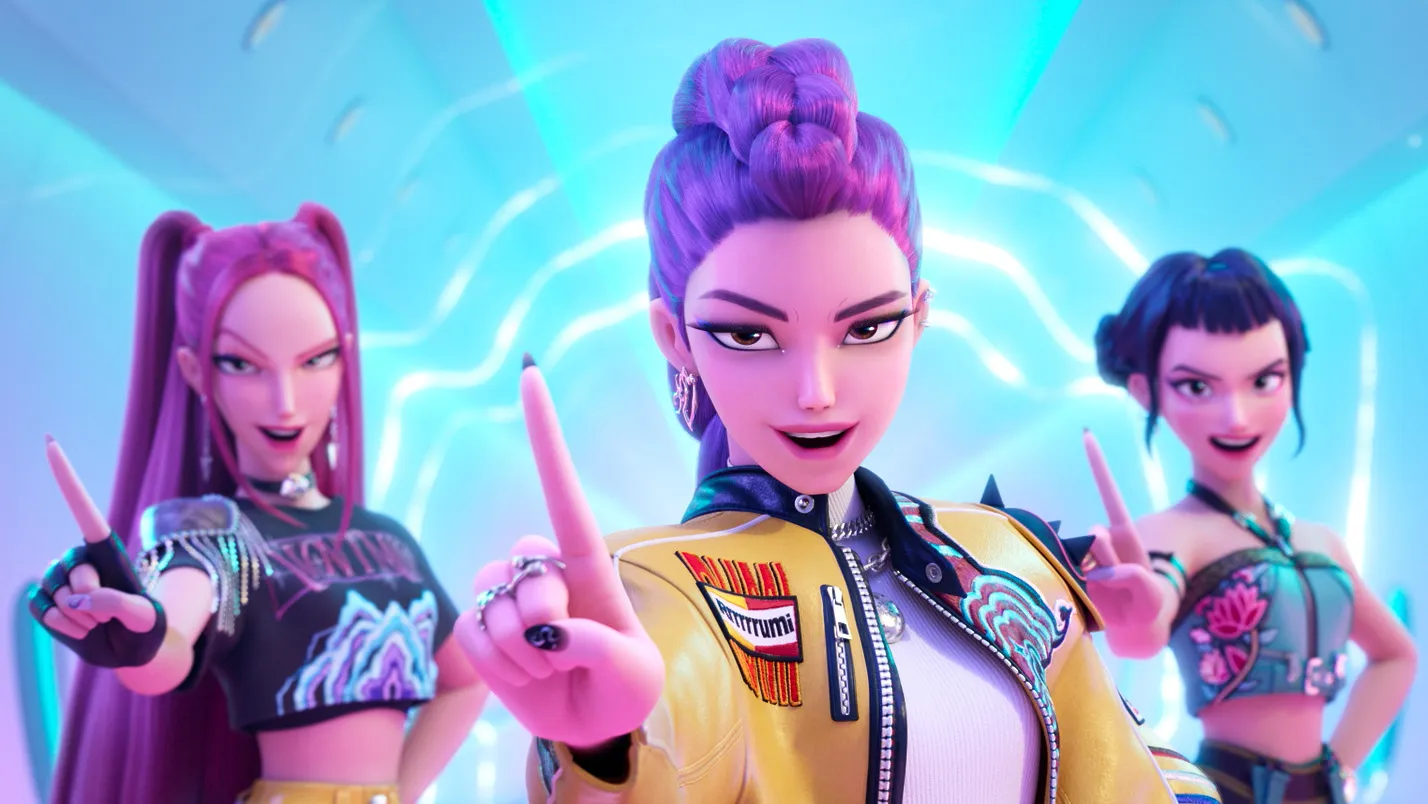
When Netflix dropped “KPop Demon Hunters” on June 20, few could have predicted that a seemingly niche animated film about demon-slaying K-pop idols would become one of the platform’s most successful titles ever, and make actual music history in the process!
But here we are, seven weeks later, watching fictional girl group HUNTR/X dominate real-world charts in ways that would make even BTS jealous.
The Sony Pictures Animation film has achieved something truly extraordinary: it’s become both a streaming phenomenon and a legitimate music industry powerhouse, proving that sometimes the most unexpected concepts can capture the zeitgeist in ways no one saw coming.
Breaking Records Left and Right
Let’s start with the numbers that are making Netflix executives do happy dances in their offices. During the week of July 28-August 3, “KPop Demon Hunters” not only secured its seventh consecutive week in Netflix’s Top 10 but officially entered rarified air among the streaming giant’s most-watched content ever.
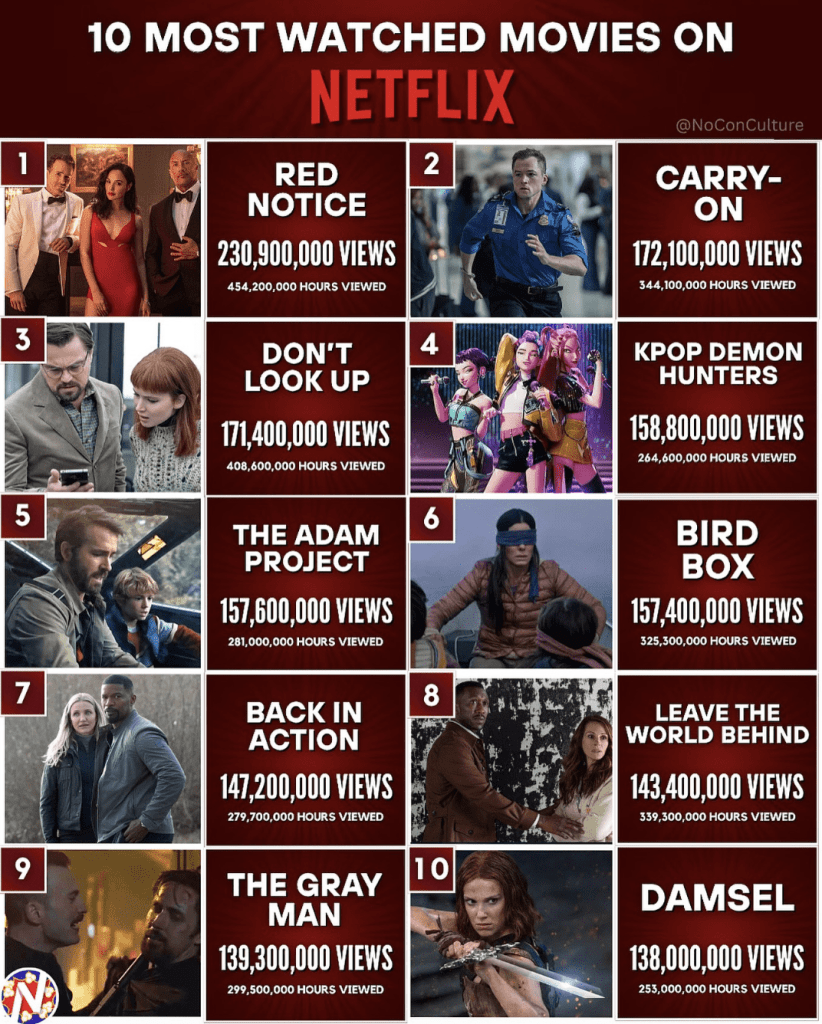
With 158.8 million views since its debut, the animated musical fantasy now sits in fourth place on Netflix’s all-time English-language films chart. Only “Red Notice” (230.9 million views), “Carry-On” (172.1 million), and “Don’t Look Up” (171.4 million) rank higher — and here’s the kicker: Netflix measures these all-time lists by accounting for views in each title’s first 91 days, meaning “KPop Demon Hunters” still has seven weeks left to potentially climb even higher.
But the film’s success extends far beyond Netflix’s platform. The movie has landed in the Top 10 across all 93 countries that Netflix tracks, hitting No. 1 in 33 nations including South Korea, Brazil, France, Mexico, and the Philippines. It’s the kind of global domination that traditional Hollywood blockbusters spend hundreds of millions trying to achieve.
When Fictional Music Becomes Real-World Gold
Here’s where things get truly unprecedented: HUNTR/X’s song “Golden” has achieved something that seemed impossible just months ago. The track, performed by real artists EJAE, Audrey Nuna, and REI AMI voicing the fictional trio of Rumi, Mira, and Zoey, has claimed the No. 1 spot on the Billboard Hot 100 with nearly 32 million streams, 8.4 million radio airplay audience impressions, and 7,000 sales in its first week.
This isn’t just a cute novelty — it’s genuinely historic. “Golden” marks several massive firsts: it’s the only No. 1 Hot 100 hit by a female K-pop group in the chart’s 60-plus year history, the first time a fictional musical act has reached the top 10 since Hannah Montana in 2009, and the first all-women collective to hit No. 1 since Destiny’s Child’s “Bootylicious” in August 2001.
Perhaps most significantly for the K-pop industry, this represents the first No. 1 for any K-pop artist ever on the Hot 100 — fictional or otherwise. Previous top spots were held solely by BTS and its solo offshoots, making HUNTR/X’s achievement a genuine breakthrough moment for female representation in the genre’s mainstream crossover success.
The Soundtrack That Conquered Charts
The success of “Golden” is just the tip of the iceberg. The entire “KPop Demon Hunters” soundtrack has become a phenomenon in its own right, holding steady at No. 2 on the Billboard 200 and logging its best week yet with 100,000 equivalent album units. The album has gained momentum every single week since its debut seven weeks ago — a trajectory that’s almost unheard of in today’s front-loaded music industry.
HUNTR/X’s rival boy band Saja Boys are also making their mark, with “Your Idol” climbing from No. 9 to No. 8 for a new Hot 100 high. Meanwhile, their track “Soda Pop” buzzes up to No. 5 on the Global 200 for a new high, becoming the act’s second top five hit globally with 51.6 million streams and 4,000 sales in the tracking week.
The global impact is even more impressive. “Golden” crowns the Global 200 with 98.5 million streams (up 20% week-over-week) and 8,000 sold worldwide, while HUNTR/X earns its second Global Excl. U.S. top 10 as “How It’s Done” rises to No. 10. The fictional groups are competing with — and beating — some of the biggest real artists in the world.
More Than Just a Movie: A Cultural Phenomenon
The film itself tells the story of HUNTR/X — comprised of Rumi, Mira, and Zoey — who use their secret identities as demon hunters to protect their fans from supernatural threats while maintaining their day jobs as K-pop superstars. When they aren’t selling out stadiums, they’re literally battling demons, including their biggest enemy yet: an irresistible rival boy band of demons in disguise.
Directed by Maggie Kang and Chris Appelhans from a screenplay by Danya Jimenez, Hannah McMechan, Kang, and Appelhans, the film boasts an impressive voice cast including Arden Cho, Ahn Hyo-seop, May Hong, Ji-young Yoo, Yunjin Kim, Joel Kim Booster, Liza Koshy, Daniel Dae Kim, Ken Jeong, and Byung Hun Lee.
The musical performances feature a who’s who of rising Asian-American artists, with original songs performed by EJAE, Audrey Nuna, REI AMI, Andrew Choi, Danny Chung, Kevin Woo, samUIL Lee, Neckwav, and Broadway legend Lea Salonga. Even K-pop stars Jeongyeon, Jihyo, and Chaeyoung contributed an original song to the soundtrack.
Social Media Dominance and Cultural Impact
The film’s impact extends far beyond traditional metrics. Social media platforms from TikTok to Tumblr to Facebook are flooded with fan content, discussions, and covers of the film’s songs. The soundtrack has become inescapable on radio, with tracks regularly rotating alongside established hits from major label artists.
This social media dominance has translated into real-world demand. Netflix and Sony are capitalizing on the momentum with “KPop Demon Hunters: A Sing-Along Event” hitting select theaters across North America on August 23 and 24. Fans will be able to sing along to chart-toppers like “Golden” and “Your Idol” in a communal theater experience — the kind of event typically reserved for established franchises with decades of history, not seven-week-old animated films.
Historic Achievements in Context
To understand just how remarkable HUNTR/X’s chart success is, it’s worth noting that “Golden” is only the second song from an animated film to reach No. 1 this decade. The first was Disney’s “We Don’t Talk About Bruno” from “Encanto,” which held the top spot for five consecutive weeks in 2022. The fact that a relatively unknown Netflix animated film has achieved similar success speaks to both the quality of the music and the power of the film’s cultural moment.
The global chart performance is equally impressive. On the Global Excl. U.S. chart, “Golden” shines at the top while multiple tracks from the soundtrack occupy high positions. This international success demonstrates that the film’s appeal transcends cultural and linguistic boundaries — no small feat for a project rooted in both American animation traditions and Korean pop culture.
The Broader Industry Implications
The success of “KPop Demon Hunters” represents several significant shifts in the entertainment landscape. First, it demonstrates Netflix’s growing ability to create cultural phenomena that extend well beyond their platform. The streaming service has moved from being a distributor of content to being a creator of genuine multimedia franchises.
Second, it shows the continued mainstream appetite for K-pop and Asian-American representation in entertainment. The film’s success comes at a time when K-pop has achieved unprecedented global popularity, but “KPop Demon Hunters” proves that Western audiences are hungry for original content that explores these themes rather than simply importing existing Korean acts.
Third, the soundtrack’s chart performance illustrates how animated films can serve as legitimate music industry players. While Disney has long dominated this space, “KPop Demon Hunters” proves that other studios can create musical content that competes at the highest levels.
What’s Next for the Franchise?
With this level of success, it’s almost inevitable that “KPop Demon Hunters” will expand into a larger franchise. The film’s ending leaves plenty of room for sequels, and the rich world-building suggests potential for spin-offs, series, or other media expansions. Netflix has a track record of capitalizing on successful original content, and this project has all the makings of their next major multimedia franchise.
The music success also opens up possibilities for real-world concert events, additional soundtrack releases, or even live-action adaptations. When fictional characters are competing with real artists on actual charts, the line between animation and reality starts to blur in fascinating ways.
A New Template for Success
“KPop Demon Hunters” has essentially created a new template for how animated films can achieve success in the modern entertainment landscape. By combining high-quality animation, compelling storytelling, authentic musical performances, and savvy social media engagement, the film has achieved something that traditional marketing campaigns often fail to accomplish: genuine cultural penetration.
The fact that “Golden” is being played on radio stations alongside tracks from established superstars proves that audiences don’t care whether their favorite songs come from “real” artists or fictional characters — they just want good music that speaks to them. In an era where the lines between virtual and reality continue to blur, “KPop Demon Hunters” feels like a glimpse into the future of entertainment.
As the film enters its eighth week of domination and HUNTR/X continues to compete with the biggest names in music, one thing is clear: what started as a seemingly niche animated film has become a legitimate cultural phenomenon that’s rewriting the rules for both streaming success and music industry achievement. In a world where entertainment options are endless, “KPop Demon Hunters” has managed to capture lightning in a bottle — and the thunder is still rolling.