
The Hunger Games: Sunrise on the Reaping review: Directed by Francis Lawrence and adapted from Suzanne Collins’ second prequel novel, this sixth theatrical entry in the franchise takes audiences back to Panem 24 years before Katniss Everdeen volunteered as tribute. By shifting the focus to a teenage Haymitch Abernathy during the deadly 50th annual Hunger Games, the film delivers an emotionally resonant return to the series’ arena-based roots. While a few familiar franchise beats feel slightly repetitive, the movie succeeds on the strength of its grounded performances and thoughtful themes about political dissent.
Back to the Second Quarter Quell
The story picks up on the day of the reaping for the Second Quarter Quell, which also happens to be 16-year-old Haymitch Abernathy’s birthday. To mark the 50th anniversary of the Games, the Capitol doubles the stakes, pulling four tributes from each district instead of two. After stepping in to replace a reluctant boy he tried to save, Haymitch finds himself ripped away from his devoted girlfriend, Lenore Dove Baird (Whitney Peak), and thrown into the Capitol’s media machine alongside fellow District 12 tribute Maysilee Donner (Mckenna Grace).
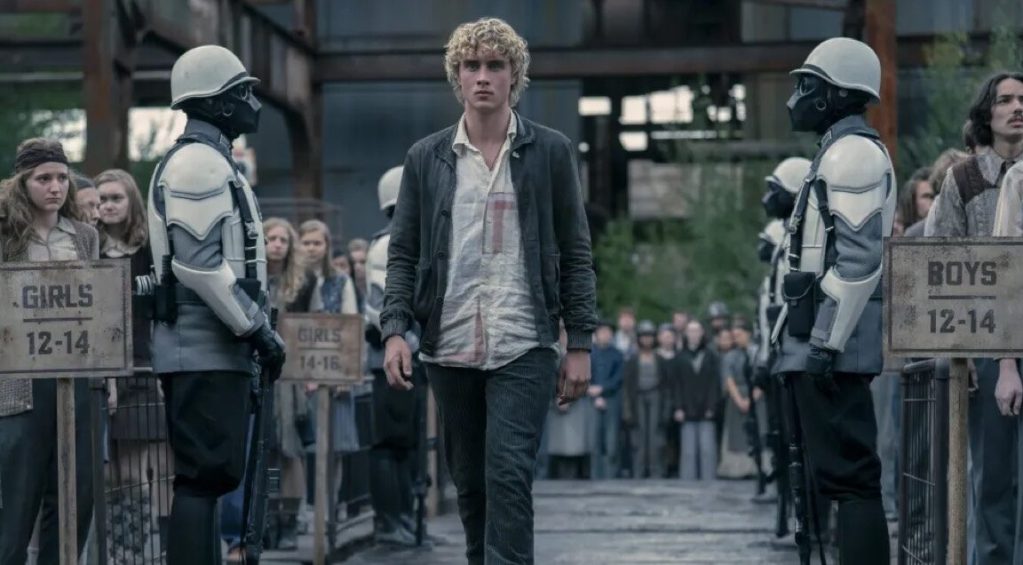
Unlike the previous prequel, The Ballad of Songbirds & Snakes, which tracked the rise of a villain, Sunrise on the Reaping brings the franchise back to the classic survival formula of the original films. Haymitch quickly draws the ire of President Snow (Ralph Fiennes) with a gesture of defiance during the opening ceremonies, putting a target on his back before the countdown even begins. Inside the arena, Haymitch attempts to set off a bomb to disrupt the Games, turning his fight for survival into an early act of rebellion.
A Stacked Cast Anchors Panem’s Past
The greatest strength of the film lies in how its young leads honor the legacy of the original trilogy without resorting to cheap impersonations. Joseph Zada is a revelation as teenage Haymitch. Rather than mimicking Woody Harrelson’s signature Texas drawl for the entire runtime, Zada saves that familiar bravado for the moments when Haymitch is forced to perform for the Capitol’s cameras. When he is alone, Zada plays the character as a sensitive, earnest, and lovesick kid, making his eventual transformation into a broken victor genuinely heartbreaking.

Mckenna Grace is equally compelling as Maysilee Donner, bringing a fierce, world-weary dignity to a character determined to hold onto her humanity until the very end. The supporting cast is packed with standout turns that enrich the wider mythology of Panem. Jesse Plemons brings quiet intelligence and a desperate hunger for change to a young Plutarch Heavensbee, showing how the future rebel leader subtly manipulates broadcast edits behind the scenes. Elle Fanning finds surprising warmth and empathy as a young Effie Trinket, while Kelvin Harrison Jr. nails the vocal cadence of a young Beetee. Even smaller appearances, like Lili Taylor as Mags, leave a lasting impression.
Candy-Colored Spectacle and Sharp Subtext
Visually, Francis Lawrence leans into a stark contrast between the Capitol’s bright aesthetic and the brutality of the Games. The arena for the Second Quarter Quell is designed like a sunlit, pastel meadow surrounded by mountains, a deceptive paradise hiding an erupting volcano and genetically engineered threats like killer rabbits and electrocuting blue butterflies. The massive sets and intricate costumes give the world a lived-in scope that makes the Capitol feel truly insurmountable.

Beneath the spectacle, the film carries a sharp, timely message about media manipulation and the cost of resistance. Watching Plutarch quietly alter what viewers see at home underscores how authoritarian regimes manufacture consent, giving the story a moral weight that elevates it above standard young adult adventure fare.
Minor Bumps in the Arena
Because this is the sixth film in the series, parts of the prolonged first act feel a bit familiar. Going through the motions of the reaping and the Capitol interviews for the third time lacks some of the raw shock value of the original movie, and a few broad character choices, like Kieran Culkin’s smarmy take on a young Caesar Flickerman and Glenn Close as District 12 escort Drusilla Sickle, occasionally lean toward caricature. There are also a couple of minor visual distractions, from a few rough CGI creatures to the ongoing franchise quirk where supposedly starving District 12 residents still sport great hair and healthy complexions. Finally, because the Second Quarter Quell features twice as many tributes, keeping Haymitch mostly isolated on his own mission makes the actual arena competition feel a bit smaller than advertised.
Final Verdict
Even when it retreads familiar territory, The Hunger Games: Sunrise on the Reaping earns its place in the saga by deepening our appreciation for the characters we already love. Fans of the books and the original Jennifer Lawrence films will find plenty to connect with, especially in how the story ties its tragic origin tale back to the hope of the wider series. It is a poignant, well-crafted blockbuster that proves there is still real heart beating inside Panem.