Let’s be honest: Beef Season 2 didn’t need to exist.
The first season, starring Ali Wong and Steven Yeun, was a lightning-in-a-bottle moment for Netflix. It featured two human Beyblades crashing and spiraling through each other’s lives following a parking lot incident that escalated into a life-ruining vendetta. It was a perfectly self-contained story—juicy, profound, and arguably one of the best TV shows of the decade.
So, when Netflix announced that Beef was pivoting into an anthology series, it was hard not to feel a twinge of cynicism. We’ve seen this movie before: a streamer pounces on a hit limited series, tries to stretch the “vibe” into a franchise, and ends up with a diluted, pale imitation of the original magic. However, after screening all eight episodes, I am relieved—and frankly, thrilled—to report that Lee Sung Jin has done the impossible. He has bottled lightning twice.
The “Beef” House Style: Familiar Trappings, New Neuroticisms
While I’d love to evaluate this season in a vacuum, the show itself won’t let you. It cleverly pulls from the same playbook of semi-inconsequential details that has now become the “Beef” house style.
If Season 1 was about the crushing weight of the working class vs. the hollow emptiness of the “girlboss” elite, Season 2 shifts the lens. We still see the recurring motifs: a character’s obsession with interior design, the looming terror of Southern California wildlife (the coyotes are back and hungrier than ever), and the physical comedy of characters tumbling down hills they have no business climbing.
The season even opens with a spiritual nod to the original road rage incident—a near-miss car accident that immediately de-escalates into a scooching traffic game of “no, YOU go.” It’s a brilliant subversion. By putting different characters in similar high-stress environments, Lee Sung Jin proves that “beef” isn’t just an event; it’s a personality trait.
The Setting: Monte Vista Point’s Gelatinous Social Strata
The setting is our first major departure. We’ve traded the suburban sprawl of West Covina for the sticky, elite social strata of Monte Vista Point (MVP), an exclusive golf and country club near Santa Barbara.
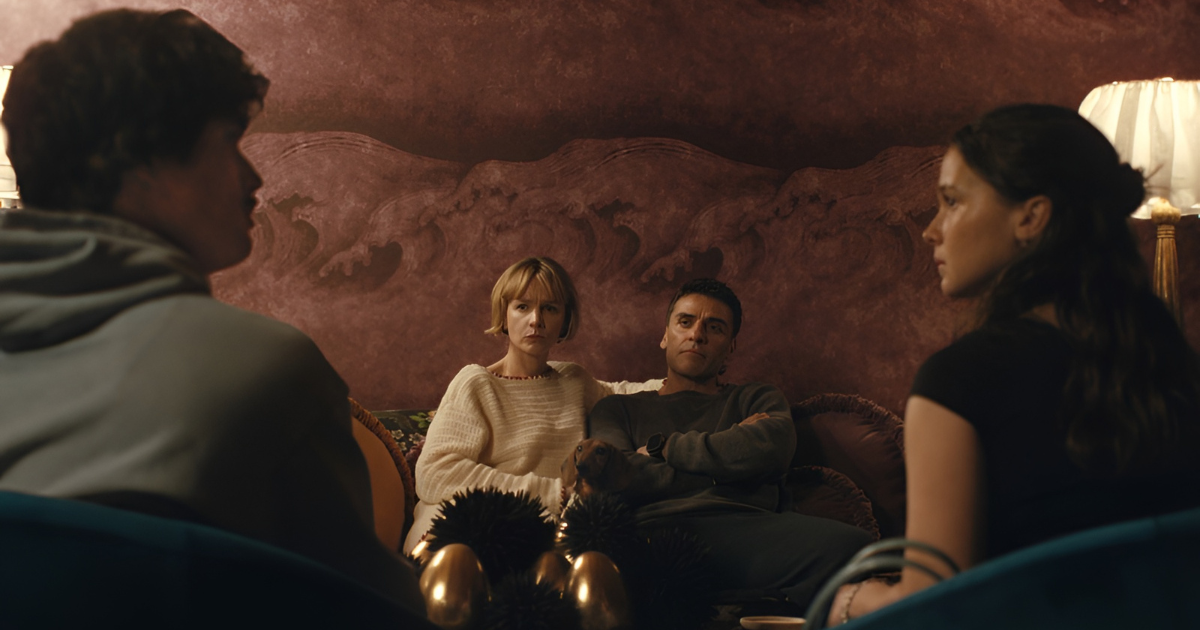
At the center of this hive is Josh Martín (Oscar Isaac), the club’s general manager. Isaac plays Josh with a “locked-in” intensity—a man who has spent his life ascending to the managerial class only to realize he’s still just a glorified concierge for people who don’t know his last name. Beside him is Lindsay Crane-Martín (Carey Mulligan). Mulligan is delightfully loathsome here; she doesn’t work at the club, but she has enmeshed herself with the “club wives” clique, weaponizing gossip and feigned support to mask a marriage that is clearly on life support.
The club’s clientele treats the staff like NPCs in their own personal RPG. They expect Josh to comp White Claws and fix tee times at a moment’s notice, and they expect Lindsay to be the bridge between their “perfect” lives and the “help.” The show constantly offers them exit ramps—moments where they could simply walk away from the “keeping up with the Joneses” lifestyle—but like a moth to a flame, they just can’t give up the prestige.
A Career-Defining Ensemble Cast
The brilliance of Beef has always been in its casting, and Season 2 is an embarrassment of riches.
- Charles Melton (Austin Davis): Following his breakout in May December, Melton has officially shed his YA/Riverdale skin. He plays Austin, a part-time trainer at the club and a total people-pleaser. He’s haunted by his glory days as a college athlete, and Melton captures that specific brand of “peaked in high school” sadness perfectly.
- Cailee Spaeny (Ashley Miller): After a string of “heroine” roles, it’s refreshing to see Spaeny play a “try-hard.” Ashley is the beverage cart girl who has spent too much time on “Therapy-Tok.” She weaponizes mental health language to justify her paranoias and lack of self-improvement, making her one of the most frustratingly relatable characters on TV.
- Youn Yuh-jung & Song Kang-Ho: The inclusion of these two legends elevates the season to prestige status. Youn Yuh-jung plays Chairwoman Park, the “richer-than-God” owner of the club. She is a quiet apex predator. Then there’s Song Kang-Ho (in his first American TV role!) as Dr. Kim, a plastic surgeon 20 years her junior. The chemistry and gravitas they bring to their limited screen time are staggering.
The Metaphor: From Interior Rot to Infestation
If the metaphor carrying Season 1 was interior rot, Season 2 is defined by infestation. The camera lingers on ants parading across bowls of expensive oranges and bees swarming in the unwanted crevices of million-dollar homes.
The “creep” is real. It starts with a simple desire—Ashley just wants a $45k salary and healthcare—but it incrementally grows into an insatiable thirst for more. As the characters act more and more deranged toward each other, the “infestation” of their warped thought patterns begins to distort their humanity. By the time they realize they’ve crossed a line, they’ve already burned the country club down.
Tone Shift: When Beef Meets Succession
Around the midpoint of the season, there is a distinct tone shift. It moves away from the “indie-dramedy” feel of the first season and sprints toward something more spiritually similar to Succession or The White Lotus.
The stakes feel more systemic. It’s not just two people mad at each other; it’s a critique of late-stage capitalism where, as a stoned Josh declares in Episode 2, “Babe, everybody’s scamming.” The only winners are the apex predators like Chairwoman Park who can leverage their wealth to fly away when the “beef” gets too hot.
The Finneas Factor: Sound and Vision
A quick shout-out to Finneas, who provides the swirling, synthy score for this season. While the first season used 90s/2000s alt-rock to ground its characters in nostalgia, Finneas uses a more contemporary, anxious soundscape that perfectly mirrors the high-stakes environment of Monte Vista Point. (Keep an eye out for his fun little cameo, too!)
Verdict: Does It Clear the High Bar?
I was wary. I didn’t think any Beef Season 2 cast could punch with the same idiosyncratic weight as the original duo. But this season delivers on every front. It is funnier, meaner, and more visually ambitious than its predecessor.
Lee Sung Jin has created a sandbox where human pettiness is the primary resource, and as it turns out, that resource is infinite. Whether you’re here for the Charles Melton Beef performance or the biting social commentary, this is mandatory viewing. Give Lee 100 seasons of this; I’ll watch every single one.
Final Score: 8.5/10