Disney’s Beloved Blue Troublemaker Takes a Leap Into Reality With Mixed Results
When “Lilo & Stitch” first crashed onto screens in 2002, the little blue alien was a glorious disruptor in the Disney universe. An anarchic, Elvis-loving troublemaker who body-slammed his way into our hearts with chaotic glee. The film’s marketing brilliantly positioned Stitch as the studio’s lovable outcast, with teaser posters showing classic Disney characters recoiling in horror at the six-limbed interloper. It was fresh, irreverent, and wonderfully weird.
Two decades later, Stitch has transformed from outsider to icon. His mischievous face adorns everything from backpacks to bedsheets, becoming one of Disney’s merchandising juggernauts. So it’s no surprise that the blue alien has been summoned for the studio’s live-action treatment—but something unexpected happens in director Dean Fleischer Camp’s faithful adaptation: in the journey from hand-drawn animation to photorealistic CGI, some of Stitch’s rebellious magic gets lost in translation.

The Taming of the Blue
Fleischer Camp, who made the charming indie hit “Marcel the Shell With Shoes On,” approaches this beloved property with reverence that occasionally feels like timidity. Where the original thrived on its unpredictable energy and Sanders-style cartoon anarchy, the live-action version operates more like a cozy Hawaiian sitcom with an alien houseguest.
The story remains wonderfully intact: a genetically-engineered alien weapon (Experiment 626) escapes to Earth, crashes in Hawaii, and is mistaken for an unusual dog. When adopted by lonely orphan Lilo, the creature, renamed Stitch, begins to discover the meaning of family (“ohana”) while evading both his mad scientist creator Jumba and the intergalactic authorities.
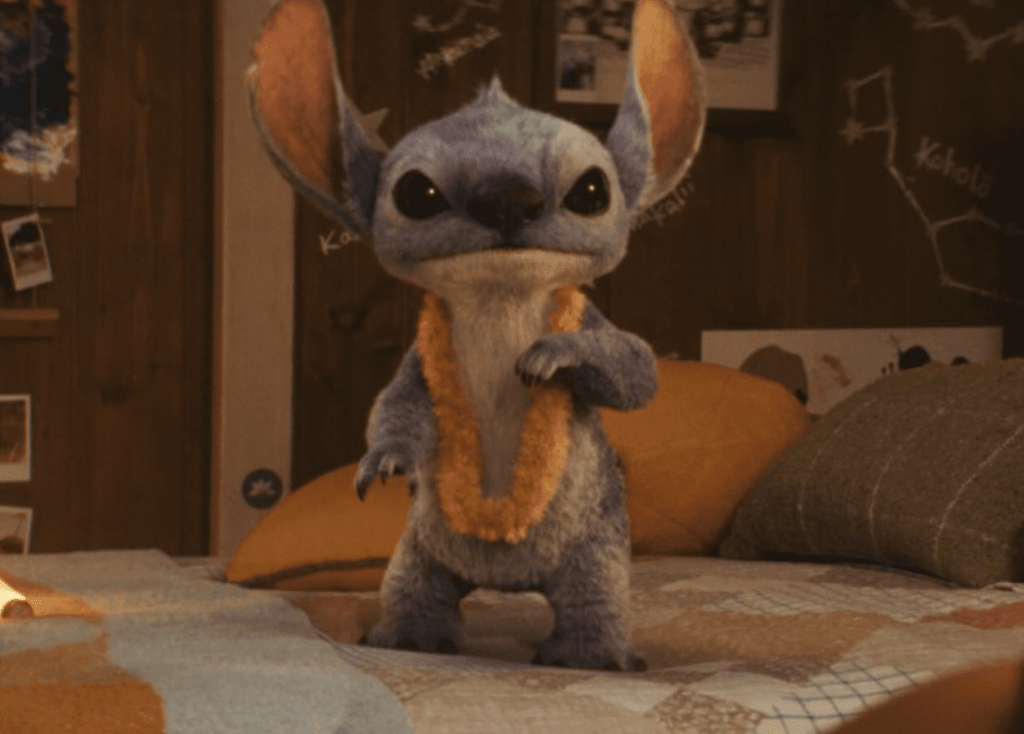
What’s changed is the visual approach. Instead of embracing the exaggerated expressiveness that made the animated Stitch so engaging, Fleischer Camp opts for a photorealistic CGI creation that looks more like a blue koala than the sleek, seal-Chihuahua hybrid of the original. This Stitch is undeniably fluffy and cute, but the subtlety of his expressions sacrifices the wild, comic energy that defined the character. We’re left wondering if something essential has been lost in the pursuit of “realism” for a character who was never meant to be real.
Casting Conundrums and Comedy Wins
The human cast offers a mixed bag. Sydney Agudong brings warmth and determination to older sister Nani, who struggles to keep her fractured family together. The film’s standout performances come from Zach Galifianakis and Billy Magnussen as aliens-in-human-disguise Jumba and Pleakley. Their physical comedy and fish-out-of-water antics provide the film’s biggest laughs and most memorable moments. Courtney B. Vance brings gravitas to UFO expert Agent Cobra Bubbles, while Hannah Waddingham commands attention as the Grand Councilwoman.

The most noticeable casting misstep is six-year-old Maia Kealoha as Lilo. Where the animated Lilo was endearingly odd and unpredictable—making voodoo dolls of her “friends” and feeding peanut butter sandwiches to fish—Kealoha’s performance feels polished and precious rather than authentically quirky. The original Lilo was revolutionary precisely because she wasn’t a perfect child; she was complicated, sometimes difficult, and utterly real. This version feels sanitized, missing the crucial tension between Lilo’s and Stitch’s similar destructive tendencies.
Expansion Without Enhancement
At 23 minutes longer than its animated predecessor, the live-action “Lilo & Stitch” adds several new sequences, including an extended surfing scene and more screen time for Tia Carrere’s social worker. These additions pad the runtime without adding substantial emotional depth, making the film feel simultaneously more bloated and less impactful than its leaner animated counterpart.

The film’s strength remains the emotional foundation at its core: the idea that family—whether biological, chosen, or created in a lab—means nobody gets left behind. This powerful message still resonates, though it’s delivered with less distinctive flavor than the original.
The CGI Conundrum
The film highlights a persistent issue with Disney’s live-action remakes: the philosophical question of how to translate stylized cartoon characters into “realistic” CGI creations. While Jumba, Pleakley and the other alien characters work surprisingly well, Stitch himself never quite clicks. The subtlety of expression that works beautifully for realistic animals in nature documentaries feels limiting for a character whose appeal lies in his cartoonish elasticity and exaggerated emotions.

When Stitch goes wild in the animated version, his eyes bulge, his teeth gleam menacingly, and his body contorts in impossible ways. In this CGI incarnation, those moments feel restrained—as if he’s been sent to obedience school between adaptations. The result is a character who feels domesticated before his story arc calls for it.
The Remake Riddle
“Lilo & Stitch” isn’t a failure—it’s made with obvious care and affection for the source material. But like many of Disney’s live-action remakes, it struggles to justify its existence beyond cashing in on nostalgia and showcasing technological advancements.

These remakes invite an uncomfortable question: If the animated versions were already perfect (or at least perfectly suited to their medium), what do we gain by seeing them translated to “reality”? With DreamWorks preparing to give the same treatment to “How to Train Your Dragon”—another Chris Sanders and Dean DeBlois creation—and “Shrek” inevitably waiting in the wings, it’s worth considering what we lose when animation’s boundless creative freedom is constrained by photorealism.
The original “Lilo & Stitch” was a celebration of outcasts finding their place—messy, emotional, and gloriously stylized. The live-action version delivers the same story with technical competence but diminished personality. It’s like hearing a beloved song covered by a skilled but overly cautious band—all the notes are there, but the raw emotion that made you fall in love with it has been polished away.
In trying to make Stitch feel real, Disney has inadvertently made him feel less alive. And that might be the most alien concept of all for a character whose chaotic spirit depended on the freedom that only animation could provide.