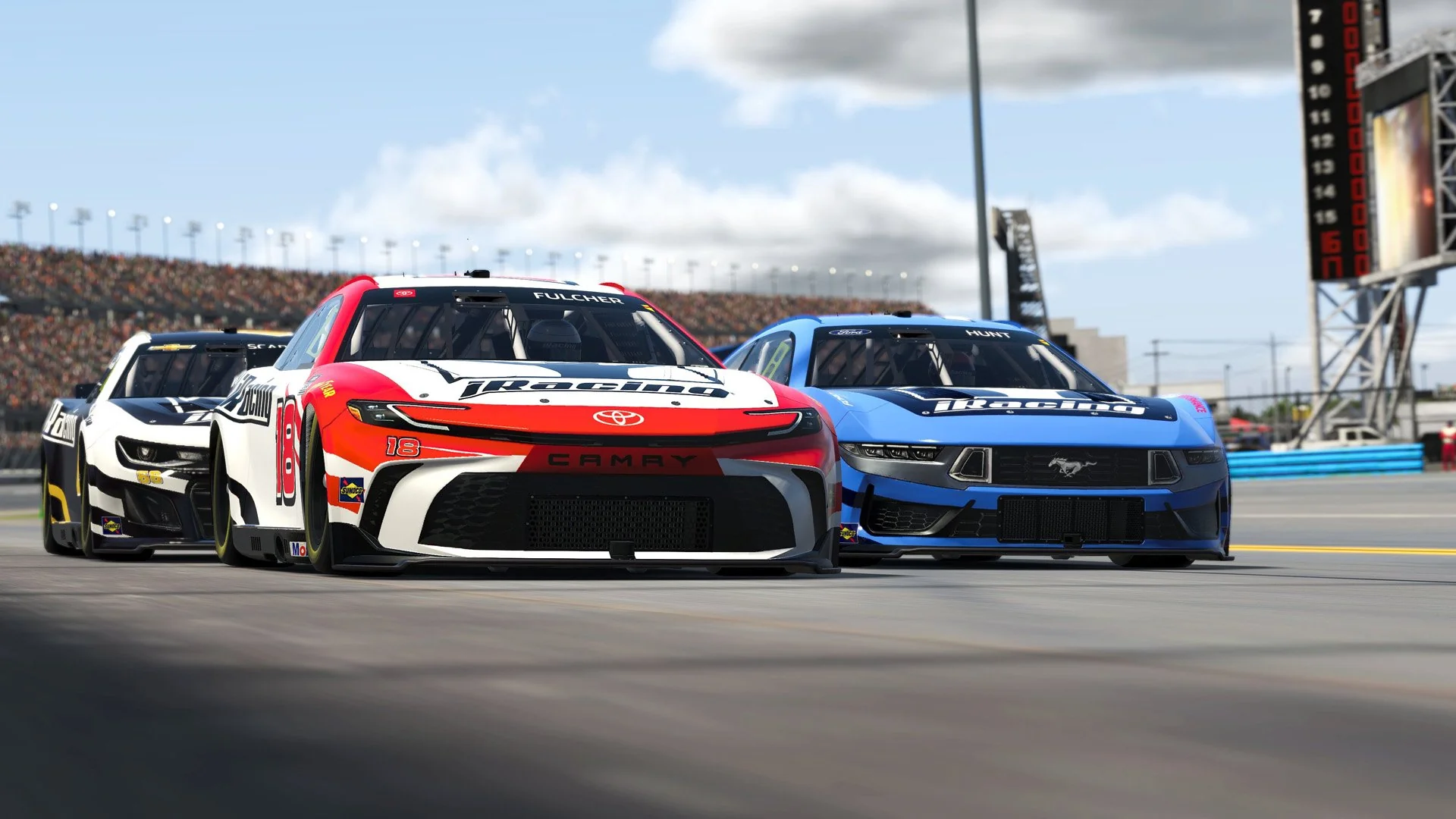
The 2000s delivered some undeniable peaks: the golden age of R-rated Hollywood comedies, Nokia phones sturdy enough to double as weapons, and—for those who know—peak NASCAR gaming. It’s not controversial to say that over the last two decades, no licensed NASCAR game has managed to dethrone NASCAR Dirt to Daytona, NASCAR Racing 2003 Season, and NASCAR Thunder 2004 from the podium.
Enter NASCAR 25, the first NASCAR-licensed console game in nearly five years and the first ever produced by iRacing—the subscription-based racing simulation beloved by professional drivers and sim-seat warriors alike. While several elements remain roughly hewn and underfeatured, and multiplayer misses the mark, the moment-to-moment single-player racing is fast, fierce, and fabulously nuanced.
Does it slingshot past the very best to ever do it? Not quite. But it’s gotten closer than any challenger in twenty years, and that makes it quite notable.
The iRacing Pedigree
NASCAR 25 arrives with legitimate credentials. iRacing’s foundation was built using source code from the legendary NASCAR Racing 2003 Season, creating an undeniable element of pedigree. There’s obvious expectation that comes with this heritage, but while the game still has scope for growth and refinement, it succeeds admirably in key areas where it counts most.
Where NASCAR 25 Shines: On the Track
NASCAR 25 is at its very best rubbing panels at nearly 200 miles per hour. While oval racing isn’t my personal specialty, I find it massively fascinating—how ruthless it can be, how fundamentally different from typical circuit racing. NASCAR 25 has me hooked.
There isn’t always a consistent racing line in oval racing. Depending on conditions and the track itself, the most efficient path through a bend might be low, somewhere in the middle, or even way up by the wall. You may need to start taking corners differently to stay competitive, and I find this necessity to adapt extremely interesting.
I’m particularly attracted to the patience oval racing requires, with events unfolding over hundreds of laps. Doggedly hanging onto the coattails of a breakaway pack, dicing doorhandle-to-doorhandle, creates tension and engagement. But there’s also something almost meditative about stalking slipstreams lap after lap, waiting for the perfect moment to lunge and strike.
AI That Gets It Right
The reason this all comes together meaningfully is NASCAR 25‘s impressive and tunable AI—exactly what I crave in racing games of this type. The core thing I constantly seek is racing I can play by myself, on my own time, that feels authentic against my skill level.
I don’t want to be at the mercy of online randos who weave unrealistically across the track. Just sell me the fantasy of being a racing driver. Let’s not kid ourselves: I’m driving pretend race cars that I can pause when I need to pee. I’m not here to take on the world; I just want to enjoy my time believing I’m mixing it up with bona fide professionals who drive accordingly.
NASCAR 25‘s AI gets this right.
As a casual NASCAR consumer from the other side of the planet, I won’t claim the AI always makes perfect tactical decisions. But they really do drive with credibility. They hold lines smoothly around corners, shrewdly carve through packs competing for position, effectively bump draft, and change lanes intelligently.
The only thing that undoes them is NASCAR 25‘s absurd corner-cutting penalty system, which literally brings your car to a halt wherever you are if it detects a track limit violation. This results in AI piling up behind you as they slam on the anchors. It’s a massive immersion killer.
AI speed operates on a difficulty slider ranging between 85 and 105 (arbitrary values). About 100 was the sweet spot for super speedways for me, slightly lower on short tracks and road courses.
Numerous settings let you customize AI behavior, including their predisposition to losing control, their skill regaining control after incidents, and their resistance to car-on-car collisions. I’m currently experimenting with making AI more susceptible to losing it after a decent whack, dialing incident frequency way up to create excitement. While it hasn’t quite resulted in the turmoil I anticipated, I appreciate these options. There isn’t one single way to play NASCAR 25—keep it stern and serious or let it lean Hollywood. The developers are happy to let us decide.
Handling: Mostly Strong
The handling news is largely positive. It feels strong and challenging with a wheel, and laser-scanned track surfaces (migrated from iRacing) mean characteristics of bumpier circuits have interesting effects on driving feel from race to race. Cars feel balanced and obedient at high speed.
I was particularly impressed with how approachable NASCAR 25 is on a controller—important for a console-oriented game. A range of assists are available, and the simple tuning slider should suffice for anyone not looking to get lost in minor vehicle adjustments. The slider essentially applies quick tunes to either tighten everything up (making your car planted and stable, at the cost of front-end responsiveness) or create something looser (and as Days of Thunder taught us, loose is fast and on the edge of out of control).
One key controller problem, however, is a peculiar lack of meaningful rumble. This creates disappointing disconnect between what’s happening with my car’s grip on-screen and what I’m feeling through my hands. It injects an unwanted floaty sensation, particularly when you don’t realize your rear tires are spinning because there’s no tactile feedback. This makes playing on expert handling settings—where ham-fisted throttle mashing will rotate your car quick smart—more frustrating than I like. It also contributes to a skatey feeling on road courses because I can’t always feel the edge of grip.
Information Deficit
Information is definitely one of NASCAR 25‘s weaknesses. It doesn’t teach players the ins-and-outs of oval tactics or road course track limits. It’s also missing useful basic info, like opposition qualifying times while you’re out setting laps—you need to return to pit lane to see where you stand.
The spotter also gives wrong information, like noting clear space inside or outside when there isn’t any. I’m lukewarm on how robotic the spotter sounds too. Being direct during racing is fine, but being unable to muster convincing human enthusiasm about winning makes him feel like a chatbot. NASCAR 25 misses out on meaningful personality as a result.
Career Mode: Functional But Sterile
Career mode presentation is a bit sterile. Your driver is never more than a blank silhouette, and the inability to even select a home state or country is odd. Missing little things makes it feel more impersonal than I’d want.
Cars can be customized using preset designs and basic shapes, but the livery system is underdone. Simple stuff like flipping designs from one side to the other hasn’t been implemented. You also can’t apply custom shapes to liveries you want to use online—an annoying restriction we don’t typically face in other racing games.
I did enjoy the evolution of the custom racing operation and garage backdrop as you progress through four series (you can compete in up to two simultaneously). But this first effort is vanilla compared to other official motorsport sim career modes like F1 or WRC. There’s a basic economy where you monitor overall budget and manage repairs between races with a secondary resource called ‘work points’, but I found myself ploughing through it without much thought.
Multiplayer: Surprisingly Bare Bones
While multiplayer isn’t my natural environment, it’s not a particularly strong component of NASCAR 25 either way—surprising given iRacing’s extensive online racing experience. NASCAR 25‘s multiplayer is simply a basic lobby system of random races. There are no scheduled races or special events.
It plays as smooth and reliably as single-player—even in races against over two dozen online opponents, which is commendable. It just feels listless.
The Verdict
NASCAR 25 is the perfect use of iRacing’s extensive stock car racing catalog, targeted at people uninterested in joining the online crucible and competing often enough to make a subscription worthwhile. As a series, it has distance to go before matching the breadth of other licensed racing games bringing real-world motorsport to your couch or sim rig—like F1. But as a debut, it impresses in several key areas.
If you’re after a deep multiplayer experience, you may want to circle back to iRacing proper. But if you want quality, single-player stock car racing against extremely solid AI, NASCAR 25 delivers convincingly.
It hasn’t quite unseated the 2000s legends from the podium. But after twenty years of pretenders, NASCAR 25 has finally gotten close enough to see the checkered flag. For NASCAR fans who’ve been waiting for a proper console racing game that respects both the sport’s complexity and the single-player experience, that’s a victory worth celebrating.